








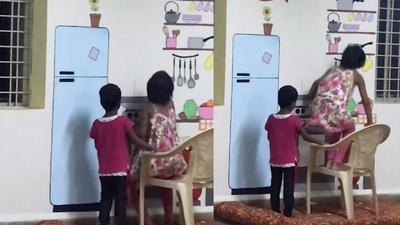
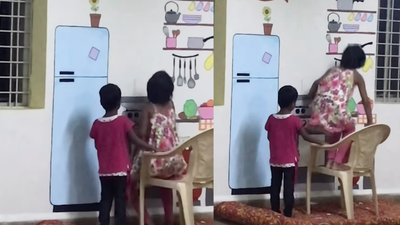
We often think of play as noise, movement, and a little harmless mess. But sometimes play becomes something far more revealing. Sometimes it shows us what a child understands about safety, belonging, and emotional warmth long before they have the words to explain it. In a video posted by MyZeroGravity on Instagram, a quiet moment inside an orphanage captured exactly that feeling. The shelter was being renovated when attention suddenly shifted to one little girl standing in front of a painted kitchen drawn on the wall. She began pretending to cook, stirring an invisible pot, serving imaginary food, and moving through the scene as though the tiny kitchen were real. There were no utensils in her hands and no actual meal waiting to be served, yet she seemed completely immersed in the moment, creating comfort and familiarity through imagination alone. Scroll down to read more…
It is a simple image. But it lands with unusual force
Because children do not just play to pass time, they play to make sense of life. They rehearse what they have seen, what they have missed, and what they hope to feel again. In many homes, pretend play is charming and easy to overlook. In places shaped by absence, however, it can become deeply telling. A child who pretends to cook may be acting out care. A child who feeds invisible people may be reaching toward connection. A child who builds a whole world out of a wall painting may be doing something extraordinary: repairing, in imagination, what reality has not yet provided.That is the quiet truth this moment exposes. Emotional security is not built only through toys, furniture, bright walls, or finished rooms. Those things matter, yes. But children remember the feeling of being held, noticed, soothed, and included far more than they remember the décor. A safe environment is not just visually pleasant. It is emotionally responsive. It is the difference between a space that is merely improved and a space that truly feels lived in. What makes the video so powerful is not sadness alone. It is the resilience hidden inside it. The child was not waiting for the room to be perfect before playing. She had already entered her own universe. She had already found a way to transform a painted outline into a domestic ritual. That kind of imagination is not trivial. It is intelligence in its most human form. It is adaptation. It is survival with tenderness attached.
For parents, that should be impossible to ignore.
Children are constantly reading the emotional climate around them. They notice whether they are interrupted or listened to, whether comfort arrives quickly or slowly, whether home feels safe enough to relax in. When those needs are consistently met, children usually play with confidence, experimentation, and joy. When they are not, play can take on a different texture. It can become repetitive, protective, or strangely intense. Sometimes, it becomes a child’s private language for saying what cannot yet be said aloud.That is why emotional security matters so much. It is not a luxury. It is the foundation. A child who feels secure is better able to explore, trust, and regulate their feelings. A child who does not feel secure may still play, still laugh, still imagine, but often with an undercurrent of longing that adults may fail to notice.The scene at the shelter also reminds us that care is never only about construction. Renovation can build a better room. Emotional attunement builds a better childhood. A new wall can brighten a corner, but consistency, affection, and responsiveness brighten the inner world. And that inner world is what children carry forward.Perhaps that is why the image lingers. Not because it is unusual, but because it is painfully familiar in spirit. So many adults were once children who filled gaps with fantasy, who acted out meals they wanted, hugs they needed, or homes they wished were warmer. Children do this not to deceive us, but to help themselves live through what is missing.And in that small performance inside an orphanage, there is a reminder every parent needs: children do not just need spaces that look cared for. They need spaces that feel emotionally inhabited. They need adults who understand that the deepest kind of security is not painted on a wall. It is felt in the body, remembered in the heart, and carried for life.