









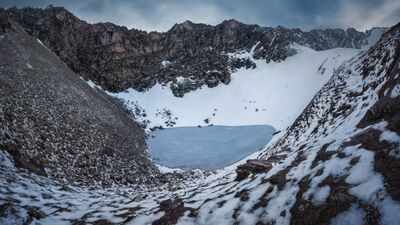
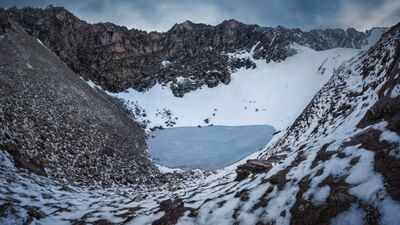
High in the Indian Himalayas, Roopkund sits like a shallow bowl pressed into the rock, half the year locked under snow and ice, the rest briefly exposed to air that barely feels breathable. It lies far above the tree line in Uttarakhand, reached only after long climbs through broken slopes and weather that turns quickly without warning. For most travellers, it is just another remote glacial lake tucked beneath Trisul’s steep flanks. Yet when the ice thins, something unusual emerges from the edges and the shallows. As reported by The BBC, human bones appear in clusters, some scattered, some half-buried, as if the lake has been quietly holding on to them for generations without giving anything away.
The first discovery of human remains by a British forest ranger in 1942
Roopkund does not behave like a typical mountain lake. It expands and shrinks with the seasons, sealed under hard ice for much of the year. When the thaw arrives, water pulls back unevenly, and the shoreline changes shape almost daily. It is during this short window that the ground begins to show its contents. Bones surface first around the margins, then further in, sometimes caught in frozen layers just beneath the water. The conditions at this height mean preservation can be strangely inconsistent. Some remains are reduced to fragments, while others still hold traces of tissue when first uncovered.The wider world only became aware of Roopkund in 1942, when a British forest ranger passed through the area and noticed human remains emerging from the ice. Local stories had circulated long before that, but nothing had been formally recorded or examined in detail. Once word spread, the lake drew attention from administrators and later from scientists trying to understand what lay scattered across its floor. Over time, estimates of the number of individuals found there settled somewhere between several hundred, though the exact figure still shifts depending on what is included in the count of fragmented remains.
Theories and speculation surrounding the mystery of the lake
For decades, the lake attracted speculation rather than certainty. One idea pointed to a group moving through the mountains under royal patronage, possibly caught in sudden, violent weather. Another suggested that soldiers returning from a failed Himalayan campaign in the nineteenth century were unable to survive the harsh terrain on their way back. There were also accounts rooted in local belief, where the deaths were tied to a sudden and destructive hailstorm described in folk memory, linked to divine presence in the surrounding peaks. Each explanation tried to make sense of the same scattered evidence, yet none fully matched the physical record left behind.
What the bones initially suggested
Early examination of the remains added another layer of confusion. Many of the individuals appeared to be adults in their middle years. Their build suggested good nutrition rather than prolonged hardship. There were no clear signs of children among the remains, which stood out against expectations for a single travelling group. The idea that everyone had died in one sudden disaster began to feel less certain over time. Instead, the distribution of remains and their condition hinted at something more complex, possibly unfolding across different moments rather than a single frozen episode.
Unresolved questions about how people reached the high-altitude lake
When modern genetic work finally reached the site, the results complicated earlier assumptions even further. A limited sample of skeletons revealed that the people did not belong to one shared background. Some carried ancestry linked broadly to South Asian populations, though even within that group, there was noticeable variation. Others showed connections to populations far beyond the subcontinent, including strands more commonly associated with regions around the eastern Mediterranean. Radiocarbon dating also separated the deaths across long spans of time, stretching in some cases across many centuries rather than a single event.The question of how such a mix of people ended up at a high-altitude lake without clear trade routes remains open. There are faint historical references to movement through these mountains linked to religious journeys, though written records become clearer only much later than some of the remains. Inscriptions and local traditions suggest that pilgrimage activity in the region may have older roots than formal accounts indicate. Still, it is not obvious how individuals with distant ancestral ties might have crossed paths here, or whether they arrived through entirely separate journeys separated by centuries.