







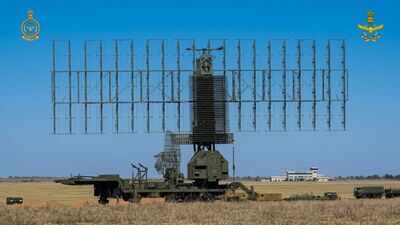
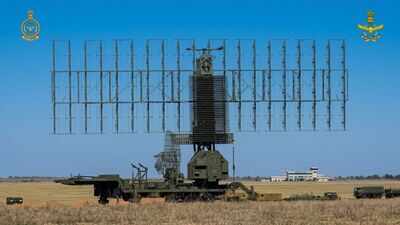
NEW DELHI: The Indian Air Force (IAF) has showcased what appears to be a powerful long-range air surveillance radar in its recently released Vayu Shakti 2026 exercise video, drawing the attention of defence analysts and military observers.Based on the radar’s distinctive antenna design and overall configuration, multiple reports have identified the system as the Russian-origin Nebo-UM Very High Frequency (VHF) radar.Although the IAF has neither officially identified the radar nor confirmed its induction into service, its appearance has renewed interest in the capabilities and strategic role of one of Russia’s most advanced long-range surveillance radars.What is the Nebo-UM radar?Developed by Russia’s Nizhny Novgorod Research Institute of Radio Engineering (NNIIRT), a subsidiary of Almaz-Antey, the Nebo-UM is a mobile three-dimensional (3D) Very High Frequency (VHF) surveillance radar designed to detect and track a wide range of aerial threats over long distances.Mounted on a high-mobility wheeled chassis, the radar is designed for rapid deployment and is intended to operate as part of an integrated air defence network.Unlike conventional surveillance radars that operate in higher frequency bands, the Nebo-UM uses VHF wavelengths, enabling it to detect targets with low radar cross-sections, including stealth aircraft, at much greater distances.Why is the radar considered effective against stealth aircraft?Stealth aircraft are designed to reduce their radar cross-section, making them difficult to detect using conventional higher-frequency surveillance and fire-control radars.The Nebo-UM addresses this challenge by operating in the VHF band. Longer VHF wavelengths interact differently with stealth aircraft, making it more difficult for low-observable designs to completely evade detection.Russia has repeatedly highlighted this capability. Almaz-Antey Director General Yan Novikov has said the Nebo-M radar family is capable of detecting advanced stealth aircraft, including the US Air Force’s F-22 Raptor and F-35 Lightning II fighters.He also described the Nebo-M radar as a major challenge for stealth technologies.
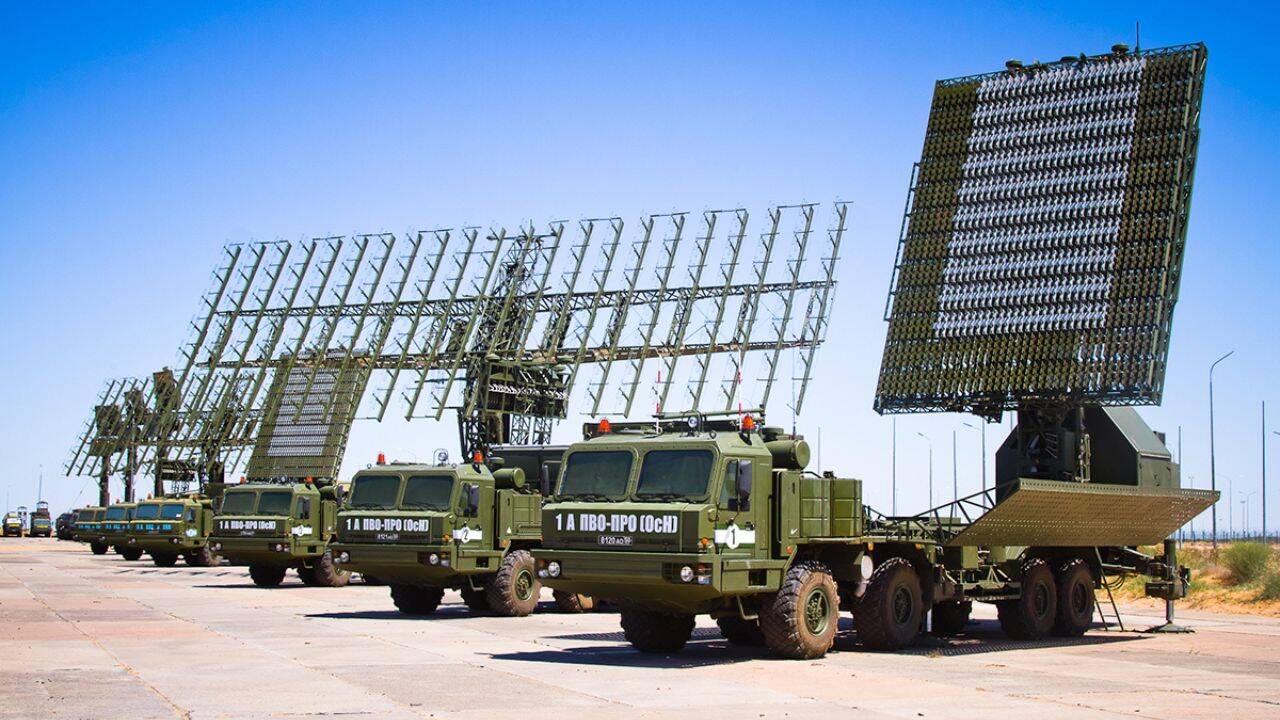
Nebo-ME. Credit : Mil.ru
What are its capabilities?According to Rosoboronexport, the export version of the Nebo-ME multifunction radar complex provides an instrumented detection range of 10 to 600 km in all-round surveillance mode. It offers 360-degree azimuth coverage, an elevation coverage of up to 70 degrees and refreshes target information every five to ten seconds.
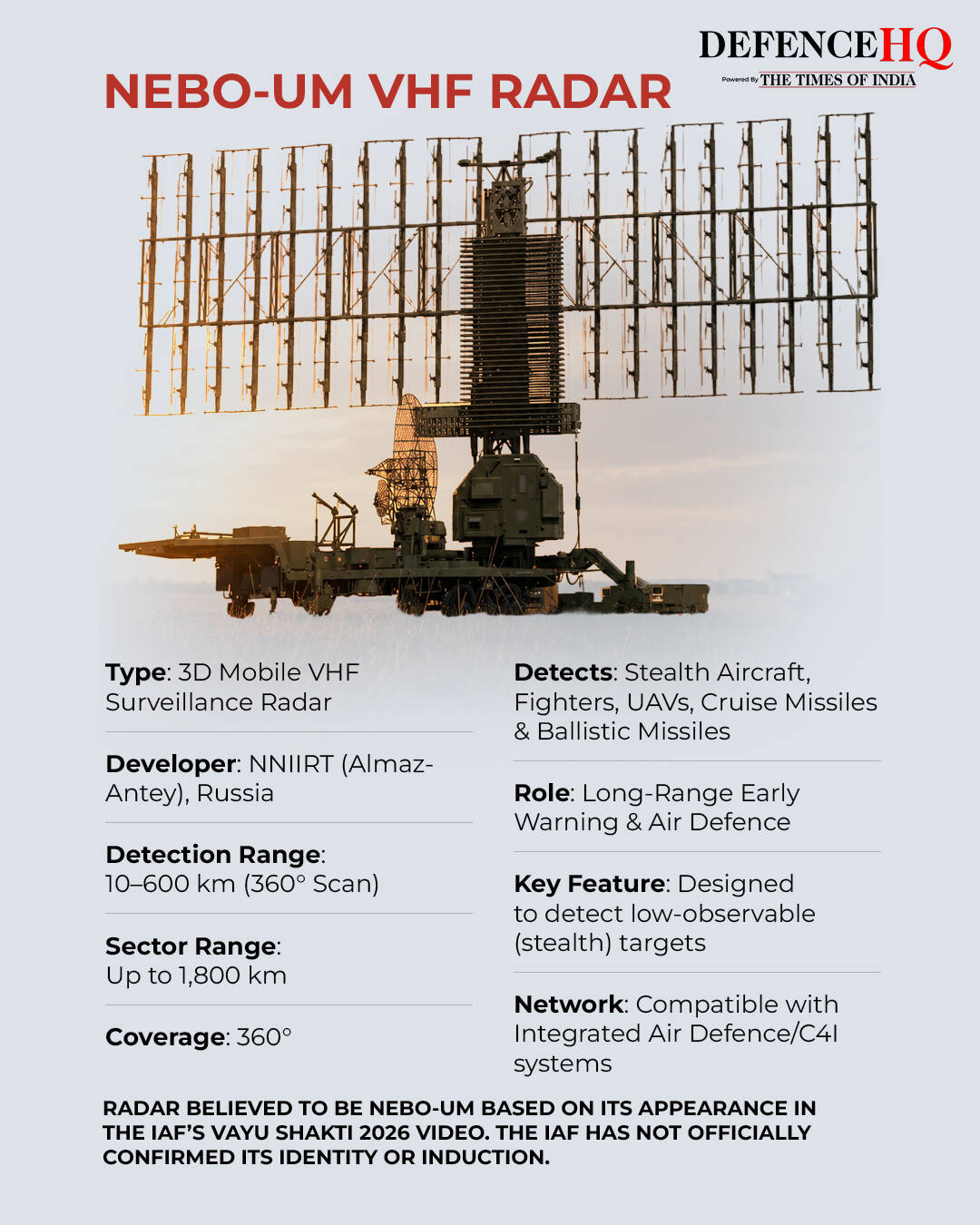
NEBO-UM VHF RADAR
In sector surveillance mode, the system has a reported instrumented detection range of 10 to 1,800 km while maintaining the same azimuth and elevation coverage and target update rate.While the Nebo-UM and Nebo-ME are different variants, they belong to the same radar family and share similar design philosophies focused on long-range surveillance and early warning.Why is it important for India?The reported sighting of the Nebo-UM during the IAF’s Vayu Shakti 2026 exercise comes as India’s air threat environment continues to evolve.China has already operationally deployed the J-20 stealth fighter in significant numbers and is also moving towards operationalising the J-35 stealth fighter, which is expected to serve with both the People’s Liberation Army Air Force (PLAAF) and the People’s Liberation Army Navy aboard aircraft carriers. Pakistan is also widely expected to acquire the J-35, potentially introducing stealth fighters on both India’s northern and western fronts.This changing threat landscape increases the importance of long-range surveillance systems capable of detecting low-observable aircraft at extended distances.Can the Nebo-UM shoot down stealth aircraft?No. The Nebo-UM is an early warning and surveillance radar, not a fire-control radar.While it cannot provide the precision required to directly guide interceptor missiles, it plays a crucial role in a layered air defence architecture. Once it detects or indicates the presence of a stealth aircraft at long range, it can pass the target’s location to higher-frequency tracking radars, airborne early warning and control (AEW&C) aircraft, fighter aircraft and surface-to-air missile systems for further tracking and engagement.By acting as the first layer of detection, the radar significantly improves the overall effectiveness of an integrated air defence network against advanced aerial threats.For India, such a capability would be particularly valuable in strengthening surveillance and early warning along both the northern and western fronts as stealth aircraft become an increasingly important part of the regional military balance.