








Mangrove forests are usually celebrated for one thing above all else, their ability to lock away planet warming carbon in their tangled roots and waterlogged soil. A new global study suggests that praise has been badly incomplete, and that these same coastal forests are quietly performing another job worth billions of dollars every year, cleaning up nitrogen pollution before it can wreck the waters around them. Researchers at the Chinese University of Hong Kong have calculated that mangroves remove roughly 870,000 tonnes of nitrogen from coastal ecosystems annually, a service they estimate is worth around 8.7 billion dollars a year if valued the same way carbon credits are, and more than twelve times higher than the value typically placed on mangrove carbon storage alone.
Why nitrogen pollution is such a serious problem
Nitrogen pollution mostly comes from synthetic fertilisers used in farming and from human waste that eventually makes its way into rivers, lakes and coastal waters. In small amounts nitrogen is simply a nutrient plants need to grow, but once it builds up beyond what an ecosystem can absorb, it fuels explosive algal blooms that can turn clear water murky and foul smelling almost overnight. When those blooms eventually die off, the bacteria that break them down consume huge amounts of oxygen in the process, sometimes leaving behind so called dead zones where fish and other marine life simply cannot survive. Dead zones caused by this kind of excess nitrogen already exist in places including the Gulf of Mexico, the Baltic and Adriatic Seas in Europe, China’s Yellow Sea, and the Gulf of Thailand, making nitrogen pollution one of the more pressing and underappreciated threats facing coastal waters worldwide.
How researchers worked out what mangroves are really doing
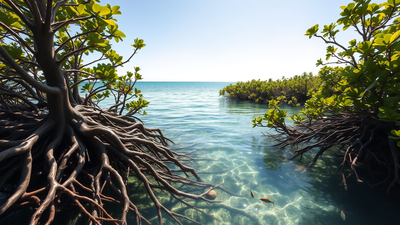
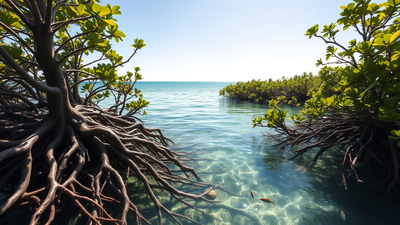
To understand exactly how much nitrogen mangroves were removing, researchers Ziyan Wang and Benoit Thibodeau carried out what they describe as the most comprehensive global analysis of the subject conducted so far. According to the study published in the journal Earth’s Future, the team combined data from 51 previously published studies along with their own unpublished measurements, covering 42 mangrove sites spread across Asia, the Americas, Oceania and Africa. Mangroves accomplish this cleanup work through the dense, tangled root systems they are famous for, which trap sediment rich in microbes that convert harmful nitrogen compounds in the water into harmless nitrogen gas, essentially removing the pollutant from the ecosystem entirely rather than simply storing it somewhere out of sight.
Why this hidden service is worth so much money
What makes the finding particularly striking is just how lopsided the comparison turns out to be against mangroves’ better known role in storing carbon. Even though mangrove forests cover less than 0.1 percent of the world’s total land area, the study found they remove nitrogen roughly twice as efficiently as ordinary land based soils manage to, and the researchers valued this nitrogen removal service using existing nitrogen credit markets, arriving at a figure of 8.7 billion dollars annually. That number dwarfs the value typically assigned to mangrove carbon sequestration alone, prompting the researchers to coin the term blue nitrogen, deliberately echoing the now familiar concept of blue carbon, to describe this parallel and until now largely overlooked ecosystem service.
What could happen if mangroves were properly protected
The study’s authors did not stop at simply measuring what mangroves are already achieving, they also modelled what could be possible if these ecosystems were actively protected and restored rather than left to shrink under continued coastal development. Under those improved conditions, the researchers found mangroves could remove as much as five million tonnes of nitrogen every year globally, offsetting roughly three percent of all human generated reactive nitrogen worldwide, a service the team calculated would be worth closer to 57 billion dollars annually if valued at current nitrogen credit rates. That is a substantial jump from current levels, and it strengthens the case for viewing mangrove conservation as directly linked to water quality management rather than treating it purely as a climate mitigation strategy focused only on carbon.
Why this cleanup service could eventually fail
The researchers were careful to add an important caveat alongside their findings, mangroves cannot remove unlimited amounts of nitrogen no matter how healthy or extensive the forest is. Their capacity for nitrogen removal has clear limits, and once nitrogen levels in the surrounding water exceed what a given mangrove system can actually process, its ability to clean the water begins to break down. This creates an uncomfortable irony, the coastal areas facing the worst and fastest growing nitrogen pollution problems are often precisely the places where this natural purification service is needed most urgently, yet also the places most likely to see it overwhelmed if pollution levels keep climbing without any real check.
Why the researchers want a new kind of credit system
Building on their findings, Wang and Thibodeau are now pushing for nitrogen removal to be formally recognised alongside carbon storage within existing ecosystem service frameworks, potentially through a combined carbon and nitrogen credit system that could generate real financial incentives for mangrove conservation. The researchers argue that mangroves already perform this dual role of storing carbon while simultaneously purifying water, offering an even stronger case for protecting them than either function could make entirely on its own. With coastal development, agricultural runoff and untreated wastewater continuing to push nitrogen pollution higher in many parts of the world, the study adds fresh urgency to a message conservationists have been making for years, that letting mangrove forests disappear does not just cost the planet a carbon sink, it quietly removes one of the ocean’s most effective natural water filters as well.