








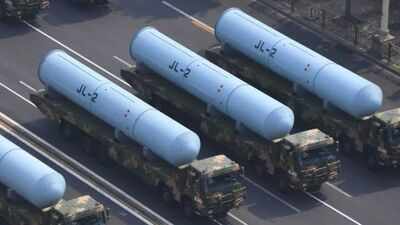
Photo credit: CSIS missile threat
China has confirmed that it test-fired a ballistic missile from a nuclear-powered People’s Liberation Army Navy submarine in the western Pacific Ocean, putting renewed focus on its expanding sea-based nuclear deterrent.A nuclear-powered submarine of the People’s Liberation Army Navy launched the missile carrying a dummy warhead towards international waters in the Pacific at 12:01 pm local time (0401 GMT), state-run Xinhua news agency reported.
While Beijing did not reveal the type of missile used, the test has once again drawn attention to China’s Julang (JL), or “Giant Wave”, family of submarine-launched ballistic missiles (SLBMs), which form a key pillar of the country’s nuclear triad alongside land-based missiles and strategic bombers.China’s SLBM programmeChina began developing a sea-based nuclear deterrent in the late 1960s as part of its effort to establish a credible nuclear triad comprising land-based missiles, strategic bombers and ballistic missile submarines.The Julang missile programme was launched alongside the development of China’s first nuclear-powered ballistic missile submarine, the Type 092 Xia class. However, technological hurdles, submarine development delays and repeated missile test failures meant it took nearly two decades before China fielded its first operational SLBM.JL-1The JL-1 became China’s first operational submarine-launched ballistic missile.It was a two-stage, solid-fuel missile with an operational range of about 1,700 to 1,770 kilometres. An improved JL-1A variant extended the range to around 2,500 kilometres.The missile carried a single nuclear warhead with an estimated yield of 250 to 500 kilotons and relied on an inertial guidance system. It was deployed aboard the Type 092 Xia-class ballistic missile submarine, which was equipped with 12 vertical launch tubes.JL-2Developed as the successor to the JL-1, the JL-2 entered operational service around 2015 and is deployed aboard the Type 094 Jin-class nuclear-powered ballistic missile submarines.Its induction enabled the People’s Liberation Army Navy to begin regular nuclear deterrent patrols, substantially strengthening the sea-based leg of China’s nuclear triad.The JL-2 is a three-stage, solid-fuel missile with an estimated range of 7,000 to 8,000 kilometres. It carries a single nuclear warhead and uses inertial guidance supported by satellite navigation updates, improving its accuracy over the JL-1.Despite its greater range, the JL-2 has operational limitations. To hold most of the continental United States at risk, Type 094 submarines would need to patrol deeper into the Pacific Ocean, moving away from relatively secure waters near China’s coastline and increasing their vulnerability to anti-submarine warfare forces.These limitations became one of the primary reasons for developing the much longer-range JL-3.JL-3First tested in 2018, the JL-3 is believed to have entered operational service around 2022. It is now being deployed aboard upgraded Type 094 Jin-class submarines and is expected to become the primary weapon of the next-generation Type 096 ballistic missile submarines currently under development.The JL-3 is a three-stage, solid-fuel missile with an estimated range of 11,000 to 13,000 kilometres. This allows Chinese submarines to strike targets across the continental United States while remaining in relatively secure waters closer to China’s coast, enhancing their survivability.According to the Pentagon’s 2025 China Military Power Report and the Federation of American Scientists, China has begun refitting its Type 094 submarines with the JL-3, while the future Type 096 class is expected to further improve the survivability and effectiveness of the country’s sea-based nuclear deterrent.Growing second-strike capabilityFrom the limited-range JL-1 to the intercontinental-range JL-3, China’s submarine-launched ballistic missile programme has evolved into a central component of its nuclear deterrence strategy.The introduction of longer-range missiles has significantly strengthened the People’s Liberation Army Navy’s sea-based second-strike capability by allowing its ballistic missile submarines to remain closer to home waters while still being able to target distant adversaries.