







Behind every generational talent is a story that started long before they were born. For Lamine Yamal, that story begins not at La Masia, not in a Barcelona training session, but on a bus leaving Morocco decades ago, carrying a woman with no ticket, no documentation, and five children left behind. Fátima, Yamal’s paternal grandmother, left Morocco alone, without documentation, and boarded a bus she had no legal right to be on. That single desperate decision quietly set in motion a chain of events that would eventually produce the most exciting young footballer on the planet.
Who is Lamine Yamal’s grandmother and what is her real story?
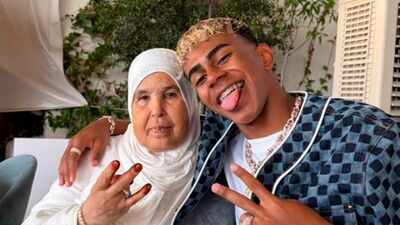
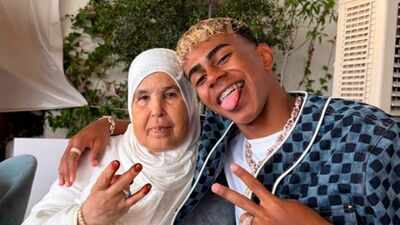
Fátima was the first to arrive on his father’s side. She sneaked onto a bus from Morocco, stopped in Algeciras and Granada, and eventually reached Mataró in Catalonia. She had nothing when she arrived. No safety net, no community to fall back on, no financial cushion. What she did have was a willingness to work herself into the ground until she could afford to bring the rest of her family across.She started working three shifts so her son Mounir could come, because he had stayed behind in Morocco, and when she had saved enough money, she paid a woman to bring Mounir and his sister across, who were just three years old at the time. Think about that for a moment. A grandmother working three jobs in a foreign country, alone, so she could eventually send money back to pay someone to transport her own toddlers safely into Spain. That is not background detail. That is the foundation on which Lamine Yamal’s entire life was built.ID@undefined Caption not available.ID@undefined Caption not available.Yamal spoke about this publicly for the first time in a 2025 podcast with José Ramón de la Morena, and the way he recalled it made clear it was not just family trivia to him. It had shaped how he understood sacrifice, identity, and what it means to carry a name that means something.“My grandmother sneaked onto the bus from Morocco and managed to get to Mataró. She started working three shifts so my father could come because he stayed in Morocco, and when my grandmother made some money, she paid a woman to bring my father and his sister, who came when they were 3 years old,” he said.Fátima is now in her 70s and still lives in the same Rocafonda neighbourhood where she first settled. She has been to matches at the Estadi Olímpic and at the Nou Camp. She has been to Morocco to watch him play for Spain. She was there almost every time it mattered.
How did Lamine Yamal’s parents meet and what was his childhood really like?
Yamal’s mother, Sheila, came to Barcelona from Guinea with her own mother, and his parents met in Spain, after which the family started living in a residence for young parents that functioned like a shared dining hall. Two immigrants from completely different parts of Africa, meeting in a Catalan city they had both arrived in through sheer necessity, raising a child in a shared housing facility. It is the kind of origin story that does not appear in most football documentaries.Sheila Ebana had given birth to Yamal at just 16 years old, something Yamal himself confirmed in a 2026 radio interview. She was not supposed to have the resources or the time to manage it all. She was a single parent working in fast food, raising a child while getting him to training, enrolling him in school, and keeping a stable home in a city where she had little support structure. The La Masia commute from Granollers, after his parents separated, was not a minor inconvenience. It was a logistical undertaking for a woman stretched thin in every direction.His parents separated when he was three, although both remained present through his childhood. His mother moved to Granollers while Mounir and grandmother Fátima stayed in Rocafonda, and Yamal would alternate between both cities to spend time with each parent. That is two cities, two households, two sets of routines, all while a child was supposed to be focused enough to develop into a professional footballer. The mental load of that alone is something most people do not factor into discussions about Yamal’s composure.As Yamal himself described it, the family always lived in the typical way where a friend would lend them a room, and that is where they stayed. No permanent address, no security, no guarantee that next month would look like this month. And yet, from that uncertainty, came someone who now plays with a kind of freedom and calm that baffles coaches and opponents alike.“After that, we always lived the typical way where a friend has a house and lets you use a room, until my parents separated. Then he went to live with my grandmother and my mother with me in Granollers,” Yamal said.The story of how Yamal got his name is one of the most heartwarming details in the family history. Two men named Lamine and Yamal had been of great help to the family just before his birth, when they needed financial assistance. His parents decided to merge the two names and give them to their son. It is a quiet tribute that nobody on the pitch knows about and nobody in the crowd sees, but every time his name is announced in a stadium, it echoes the kindness of two strangers who helped a struggling young couple when they had nowhere else to turn.
What was the most painful moment in Lamine Yamal’s personal life off the pitch?
In August 2024, Mounir Nasraoui was stabbed several times in a parking lot in the Catalan town of Mataró. He was hospitalized with serious injuries after the attack, and speaking publicly after the incident, he admitted how close he came to losing his life, saying: “I saw myself between life and death.”Yamal learned about it while sitting in a car. He had CarPlay on and his cousin, who was in Morocco, called him. He was 17 years old. His father was in intensive care. And he was days away from the start of his first full senior season at Barcelona.Relatives locked him in his house to prevent him from rushing to the scene. That detail matters. It was not a composed athlete deciding to stay calm and focus on football. It was a teenager being physically kept indoors by people who knew he would not make a rational decision if left to himself. That is the version of Yamal that the public rarely gets to see, and it is the version that explains a lot about the player who walks out looking unshakeable every week.He played anyway, days later. Scored. Performed. Said nothing publicly until September 2025, when he finally opened up about how much it had cost him emotionally. The fact that he calls the stabbing the most painful memory of his life, over every difficult match, every injury, every defeat, is the most honest thing he has ever said about himself.His mother, who once transferred between McDonald’s branches to keep him in training, had a house bought for her by her son in September 2025. Fátima, who once sneaked onto a bus with nothing, sat inside FC Barcelona’s headquarters and watched her grandson sign one of the most significant contracts in the club’s recent history. And Mounir, who nearly died in a car park in the neighbourhood where Lamine grew up, recovered fully and continues to attend every match he can, posting his son’s goals on social media with visible, unfiltered pride.The “304” celebration Yamal throws after every goal is not just a postcode. It is a direct acknowledgement that Rocafonda, a working-class immigrant neighbourhood most of Spain had never heard of, produced something the world is still trying to fully understand. The gesture is for his grandmother, his father, his mother, and every family that crossed a border with nothing and built a life anyway.