








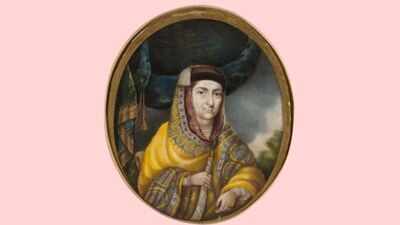
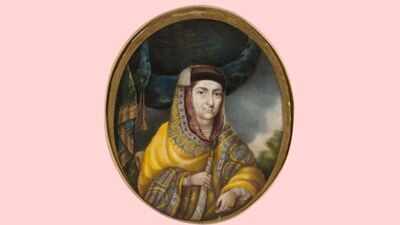
In Uttar Pradesh’s Sardhana lies the Basilica of Our Lady of Graces. A basilica is a title of privilege conferred by the Pope on churches of historical or artistic significance. There are more than 70 basilicas in Asia and India with 28 basilicas having the most. But how did a church in a small town become a basilica? Because of its founder, Joanna Nobilis Sombre, nee Farzana Zebunissa, also known as Begum Samru.The late queen’s tomb lies inside the church, topped by an imposing 18-foot marble statue of her seated on a throne, surrounded by her Indian and European associates. The intricate bas-reliefs on the tomb provide glimpses into her life story, which was as regal as dramatic.
A begum in the making
Not much is known about Begum Samru’s childhood. According to a report by Storytrails, historians believe that she was born Zebunnissa to Mughal nobleman Latif Ali Khan, near Delhi. Her father died when she was still young, and she and her mother were thrown out of the family villa by Latif’s first wife and son. They arrived in Delhi penniless, and soon her mother passed away. A young Zebunnissa found refuge in a popular courtesan’s house and was trained to entertain men. She was a smart, attractive teenager who was quick and eager to learn.In 1767, she met Walter Joseph Reinhardt, a Franco-German mercenary, at the courtesan’s house and left to live with him. While she was still a teenager, he was in his forties. India at that time was full of risky opportunities. Mughals were declining while Marathas, Sikhs and Mysoreans were expanding, French and British were trying to outsmart each other while edging out the Dutch and there were numerous other smaller kingdoms in play.European soldiers of fortune were drawn to the subcontinent and Reinhardt was one of them. He enlisted as a private in the French army and arrived in India under the name ‘Summer’. Because of his serious demeanour, however, he earned the nickname ‘Le Sombre’, and the name stuck, which eventually became the Indianised ‘Samru’.As a mercenary, Samru served the highest bidder including the French, the British and Mir Qasim, the British-installed Nawab of Bengal. For a while, he was the general of the Bharatpur army and even served as Governor of Agra. He raised his own army of Indians and Europeans, trained them in the finest French and British methods. His services were in high demand as he travelled through Lucknow, Rohilkhand, Agra, Bharatpur, Delhi, and various regions along the Ganga-Yamuna Doab. Zebunnissa was his constant companion, even participating directly in the military campaigns, learning life’s lessons on the fast track.At one point, Samru served the Mughal king Shah Alam II and left a profound impression on him. As a gesture of appreciation, he granted him the jagir of Sardhana, making Samru its feudal ruler. As the couple prepared to settle down there, Samru passed away in 1778, leaving Zebunnissa devastated. However, she quickly assumed command of her husband’s mercenary army and the troops accepted her authority.She emerged as a hands-on leader, leading cavalry charges herself. She impressed the Mughal ruler and ensured that Sardhana Jagir was transferred legally to her. His trust was well placed, because twice she rescued him from a tight spot. In 1783, she negotiated a settlement with the Sikh General Baghel Singh at Tis Hazari, preventing an attack on Delhi in exchange for a generous payment by Shah Alam. In 1787, she broke the siege of Red Fort by the Rohilla chieftain Ghulam Abd al Qadir Ahmed Khan with a bold attack. Shah Alam was so grateful that he gave her the title Farzand-e-Azizi (meaning ‘beloved daughter’) or Farzana for short.
A reigning queen
Begum Samru even fought the British. In the Battle of Assaye in 1803, she fought alongside the Maratha. While the Maratha alliance suffered defeat, her army did not scatter and retreat, deciding to fight another day. But by 1803 she realised that the British were the emerging superpower and sued for peace. At the peace talks, British General Lake was so impressed by her that he gave her a kiss, scandalising her troops. She pacified them by explaining it away as a fatherly kiss and soon became a British ally, while still retaining her autonomy.Not just military, she also aced civil administration. Under her rule, the Sardhana Jagir flourished, generating substantial revenues. She also built several magnificent monuments, including a palace in Chandni Chowk, which allowed her to remain close to the Mughals, who were almost like family to her. This palace became a site of action during the 1857 mutiny. Now called Bhagirath Palace, it houses the Central Bank. In Sardhana, one of her palaces currently serves as St. Charles Inter College, while another functions as a boys’ school. Her Jharsa Palace near Gurugram serves as the District Collector’s quarters.But one of the most significant monuments of her time is the basilica. In 1781, Begam Samru converted to Christianity. While the reason for the same remains unknown, she took the Christian name Joanna Nobilis Sombre and became the first and only native Catholic ruler of an Indian princely state.She commissioned her own Italian military engineer, Major Anthony Reghelini, to build a church for Sardhana. The minarets outside and the pietra dura inside are inspired by Mughal design while the dome and marble work are inspired by St. Peter’s in Rome. It cost Rs 4 lakhs to build (a huge sum then) but Reghelini erected a sturdy church that has withstood the test of time for two centuries, without any major issues.In 1822, the church opened its doors to the public and Begam Samru wrote to Pope Gregory XVI requesting the appointment of a bishop. He obliged by sending Bishop Julius Caesar Scotti in 1834. Two years later, she died at the age of 83. Since she had no children, she bequeathed most of her property to Reinhardt’s son from his previous marriage. But the British usurped most of the estate that was valued at a whopping $4 billion at 1953 rates.But the basilica remains, standing tall to date. Recognising its rich history, Pope John XXIII elevated it to the status of a basilica in 1961. It serves as a reminder of a woman who refused to succumb to life and created her own path, regardless of time and age.