







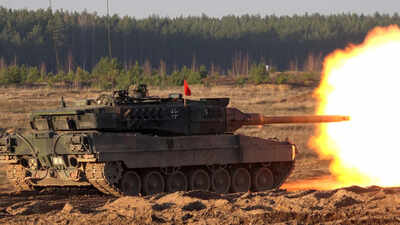
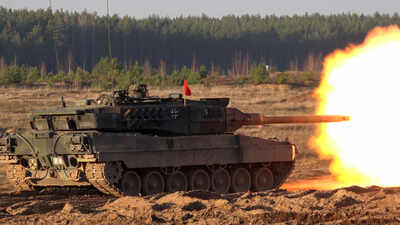
The main battle tank, long regarded as the backbone of modern land warfare, is undergoing its biggest transformation in decades. Lessons from the Ukraine war and the rapid proliferation of drones, precision-guided missiles and loitering munitions have exposed vulnerabilities that militaries around the world are now scrambling to address.Rather than replacing tanks, armies are redesigning them for a battlefield where threats increasingly come from above and where survival depends as much on sensors and software as on armour and firepower. The result is a new generation of tanks built around survivability, adaptability and integration with unmanned systems.One of the most significant upgrades is the adoption of Active Protection Systems (APS). Systems such as Israel’s Trophy APS use radar to detect incoming anti-tank missiles and rockets before launching interceptors to destroy them in mid-air. These systems have become increasingly important as inexpensive precision weapons have proved capable of knocking out multi-million-dollar tanks.Protection against aerial threats has also become a priority. Tanks are now being fitted with reinforced top armour to withstand attacks from drones and top-attack munitions, which have repeatedly demonstrated their effectiveness in Ukraine. Many are also integrating Counter-Uncrewed Aerial Systems (C-UAS), including electronic jammers and remotely operated weapon stations capable of disrupting or shooting down hostile drones.Another battlefield innovation is the widespread use of cope cages—steel lattice structures mounted above tank turrets. Originally seen as an improvised solution, these cages are designed to reduce the impact of loitering munitions and top-attack drones. While their effectiveness remains debated, their rapid adoption reflects how militaries are adapting to an increasingly drone-dominated battlefield.The tank is also evolving into a launch platform for unmanned systems. Future armoured vehicles are expected to carry canisterised loitering munitions that can be launched directly from the tank, allowing crews to engage targets far beyond their line of sight without exposing themselves. This represents a major doctrinal shift, transforming tanks from direct-fire platforms into networked strike systems capable of conducting long-range precision attacks.Digital connectivity is emerging as another defining feature of next-generation tanks. Modern armoured vehicles are increasingly being built around modular, open-systems architecture that enables seamless data sharing with infantry, artillery, command centres and reconnaissance drones. Real-time battlefield awareness allows commanders to detect threats faster and coordinate strikes with greater precision.Automation is reshaping tank design as well. Autoloaders are reducing crew requirements from four soldiers to three, paving the way for unmanned turrets that improve crew protection while reducing vehicle weight and enhancing mobility. Hybrid-electric propulsion systems are also under development, offering quieter operation, lower thermal signatures and improved fuel efficiency—advantages that make tanks harder to detect while extending their operational range.Many of these technologies are already finding their way into next-generation platforms. Germany’s Leopard 2A7+ and the United States’ upcoming M1E3 Abrams incorporate advanced protection systems, digital networking and improved survivability features, while Russia and China are pursuing similar concepts. The convergence of active protection, drone integration, electronic warfare and hybrid propulsion reflects a growing consensus that tanks must evolve to remain relevant.Far from becoming obsolete, the tank is being reimagined for a new era of warfare. The armoured vehicles of the future will not simply rely on thicker armour or bigger guns. They will operate as digitally connected, drone-enabled combat systems capable of protecting themselves against missiles, countering aerial threats and striking targets far beyond the traditional battlefield.The age of the tank is far from over. But its future will depend less on the thickness of its armour than on the intelligence of the systems it carries.