






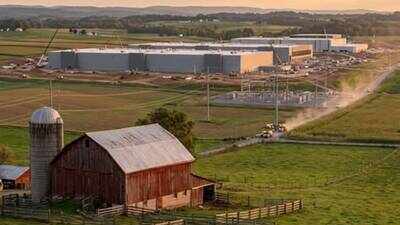
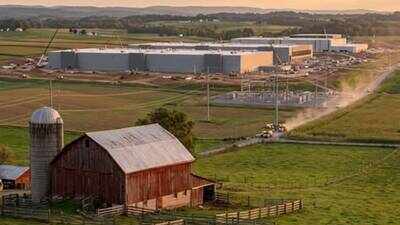
The AI data center boom is changing the fortunes of families across rural America, and one Pennsylvania couple has become one of its biggest beneficiaries after selling their 89-acre hog farm for more than $22 million.David and Marilee Kiliti, who had spent years raising and butchering hogs on land that had been in their family for around 80 years, never imagined their struggling farm would attract such a massive offer. According to The Wall Street Journal, when developers first approached them nearly two years ago saying the property could be worth more than $20 million, they thought it was a prank.
AI data centers drive land prices higher
The land wasn’t valuable because of oil, gas or minerals beneath it. Instead, developers were interested in something far more critical for the AI era, electric power infrastructure.The farm is located in Salem Township, Pennsylvania, where existing transmission lines and substations already supply electricity from a natural gas plant and the 2,475-megawatt Susquehanna Steam Electric Station nuclear plant.The growing demand for electricity to power AI data centers has made land near major power sources increasingly attractive to developers.
Blackstone-backed QTS buys 1,700 acres
The Kilitis are among 96 families in Salem Township, home to about 4,000 residents, who collectively sold around 1,700 acres to QTS, the data center company backed by Blackstone.The combined value of those transactions reached $586 million, averaging around $330,000 per acre or roughly $5.5 million per family, according to The Wall Street Journal.County property records show Salem Township Holdings LLC assembled the land before transferring it to QTS earlier this year. Records also show Kiliti’s Family Farm LLC sold one parcel for $17.77 million, along with several adjoining properties.
Amazon Web Services already has a major presence
The region has already emerged as a hotspot for AI infrastructure.In March 2024, Amazon Web Services (AWS) acquired the neighbouring 1,200-acre Cumulus data center campus from Talen Energy for $650 million. The company later signed a long-term electricity supply agreement extending through 2042, with power demand expected to increase to 1,920 megawatts.The area’s ready access to reliable electricity has made it one of the most sought-after locations for large-scale AI data centers.
From debt to financial freedom
Before selling the farm, the Kilitis were struggling financially.The couple had cashed in a life insurance policy and borrowed money to build a new hog barn, a project that was later blocked by neighbours.The land sale has completely changed their situation.They have paid off their debts, purchased a Toyota Sequoia, and are planning to buy a Polaris Slingshot. The family is also planning a summer vacation with 20 relatives at a 10-bedroom home near Breckenridge, Colorado.The windfall has benefited the next generation as well. One daughter has purchased a local brewery, while another, who is a doctor, plans to establish a cancer research foundation.
Thousands of jobs expected
Supporters of the project say it could become a major employment generator.David and Marilee Kiliti pointed to QTS estimates that each of the proposed 12 data center buildings would create around 50 permanent jobs, along with more than 1,500 construction jobs during development.QTS says the project will create or support over 6,000 jobs annually throughout an estimated 10-year construction period.To accommodate the development, township officials amended zoning rules in 2025, creating a nearly 3,980-acre data center overlay district, later expanding it by another 118 acres.
AI investment shifts toward rural America
The Salem Township story reflects a broader trend across the United States.A Pew Research Center analysis found that while 87% of the country’s existing data centers are located in urban areas, 67% of those currently planned are being built in rural communities, where land is cheaper and access to power is often easier.The surge is being driven by enormous AI investments from technology giants. Alphabet, Amazon, Meta and Microsoft are expected to spend a combined $725 billion this year on capital expenditures, up roughly 77% from 2025, with AI data centers accounting for the bulk of that investment.