








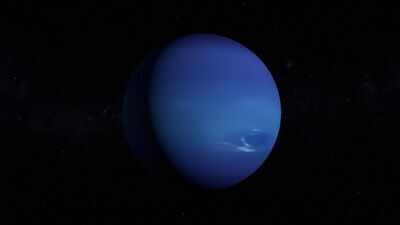
At first glance, Neptune seems like the last place where violent weather should thrive. The ice giant circles the Sun at an average distance of about 4.5 billion kilometres, leaving it in a region where daylight is remarkably faint. Even at midday, the sunlight reaching Neptune would resemble a dim twilight compared with conditions on Earth. Yet that distant world produces winds that outrun anything measured elsewhere in the solar system, racing across its atmosphere at more than 2,000 kilometres per hour.That contrast has puzzled planetary scientists for decades. Distance from the Sun usually means less energy to drive atmospheric activity, but Neptune refuses to behave as expected. Instead of a quiet, frozen planet, spacecraft observations revealed cloud bands, enormous storms and relentless winds moving at extraordinary speeds. As Nasa puts it, Neptune is “our solar system’s windiest world,” despite receiving far less solar energy than the inner planets.
The surprising reason Neptune’s winds are faster than those on any other planet
The amount of sunlight reaching Neptune is dramatically lower than what Earth receives. According to Nasa, “The warm light we see here on our home planet is roughly 900 times as bright as sunlight on Neptune.” At an average distance of 4.5 billion kilometres from the Sun, light itself takes around four hours to arrive at the planet.Ordinarily, sunlight is the main source of energy shaping a planet’s weather. Earth’s winds are largely driven by uneven heating from the Sun, creating differences in temperature and pressure that move air around the globe. Neptune, however, appears to rely on something else.Scientists think the planet generates a substantial amount of heat from its own interior. While the Nasa facts page does not explain the precise mechanism behind that internal energy, it highlights an apparent contradiction: even with such limited solar input, Neptune produces winds far stronger than those found on either Earth or Jupiter.
Neptune’s 2,000 km/h winds: Why they are faster than Jupiter’s and Earth’s
Neptune’s atmosphere is composed mainly of hydrogen and helium, with a smaller amount of methane. That methane gives the planet its familiar blue appearance by absorbing certain wavelengths of sunlight while reflecting blue light into space.Those same methane-rich clouds are carried across the planet at astonishing speeds. According to Nasa, “Despite its great distance and low energy input from the Sun, Neptune’s winds can be three times stronger than Jupiter’s and nine times stronger than Earth’s.” The agency adds that these winds move frozen methane clouds at “more than 1,200 miles per hour (2,000 kilometres per hour),” while Earth’s strongest winds reach only about 250 miles per hour (400 kilometres per hour).That enormous difference means Neptune holds the record for the fastest sustained planetary winds known in the solar system, despite existing in one of its coldest and darkest environments.
Voyager 2 revealed Neptune’s great dark spot and extreme storms
Neptune’s powerful winds do more than push clouds around. They also shape immense weather systems that can appear and disappear over time.When Voyager 2 flew past Neptune in 1989, it observed a vast storm known as the Great Dark Spot. According to Nasa, this oval-shaped feature in the southern hemisphere was large enough to contain the entire Earth. By the time astronomers looked again years later, the storm had vanished, while new dark storms had formed elsewhere on the planet.The fly-by remains a landmark in planetary exploration. Voyager 2 is still the only spacecraft to have visited Neptune, providing the images that first revealed the planet’s banded clouds, changing storms and remarkably active atmosphere. Nasa describes Neptune as “dark, cold, and whipped by supersonic winds,” a summary that captures why the distant ice giant continues to surprise scientists. Neptune’s weather challenges a simple assumption that more sunlight automatically produces stronger planetary winds. Instead, the planet demonstrates that atmospheric dynamics can be shaped by factors beyond solar heating alone.Scientists continue studying how Neptune’s internal heat, atmospheric structure and rapid circulation combine to generate winds unlike those on any other known planet. Even after decades of research, the eighth planet remains one of the solar system’s most unusual worlds.