






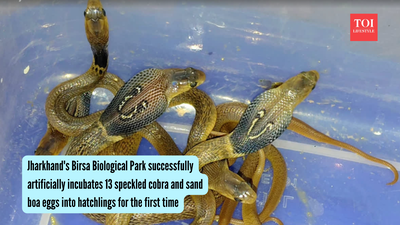
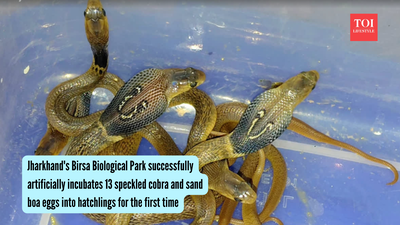
The Bhagwan Birsa Biological Park in Ormanjhi, Ranchi, successfully achieved artificial incubation of Spectacled Cobra eggs for the first time in the facility’s history, resulting in five healthy hatchlings. Apart from this, the park also recorded the birth of eight healthy Sand Boa hatchlings during the same period, adding to its ongoing reptile conservation and breeding initiatives.
How was the incubation was carried out
According to Dr Om Prakash Sahu, veterinarian at the park, seven Spectacled Cobra eggs were placed inside a controlled artificial incubation system where temperature and humidity were carefully regulated. The eggs were monitored for nearly 70 to 72 days, following established scientific protocols, before five hatchlings successfully emerged. Dr Sahu called it “the first instance of successful artificial incubation of Spectacled Cobra eggs at the park.” The process was overseen by zoologist and herpetologist Vivekananda Kumar, who monitored the eggs closely throughout development.The incubation process was conducted and completed under the guidance of Vivekananda Kumar, a zoologist and herpetologist inassociation with the biological park. The eggs were closely monitored and maintained under controlled environmental conditions to ensure the correct development.
Scientific management has become an important part of wildlife conservation
Zoo Director and IFS officer Jabbar Singh described the success as proof of how important scientific management has become in reptile breeding and conservation efforts. According to Singh, “The successful artificial incubation of snake eggs is the result of scientific methodology, dedicated teamwork and the park’s commitment to wildlife conservation. This achievement is a matter of pride for the institution and is expected to provide new momentum to reptile conservation, research and scientific breeding programmes in the future,”
What comes next for the hatchlings
The newly hatched cobras and sand boas are currently under close observation at the park, with Dr Sahu and other experts tracking their health, growth, and behaviour. Officials also said that the hatchlings will continue receiving veterinary care and regular monitoring. The Forest Department stated that the park will keep promoting scientific research and conservation work aimed at protecting biodiversity and strengthening captive breeding programmes across the state.The achievement is being seen as a meaningful step for reptile conservation in Jharkhand, one that could help refine breeding techniques used at the facility and beyond in the years ahead.