





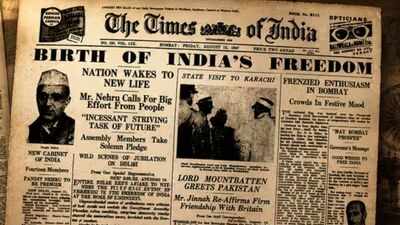
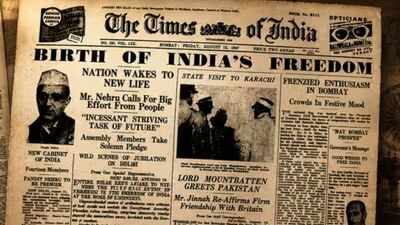
“At the stroke of the midnight hour, when the world sleeps, India will awake to life and freedom. A moment comes, which comes but rarely in history, when we step out from the old to the new, when an age ends, and when the soul of a nation, long suppressed, finds utterance. It is fitting that at this solemn moment, we take the pledge of dedication to the service of India and her people and to the still larger cause of humanity.”With those words, the first Prime Minister of Independent India, Jawaharlal Nehru, gave voice to one of the most consequential moments in the country’s history.As the date changed from August 14 to August 15, 1947, nearly two centuries of British rule formally came to an end and India emerged as an independent nation.But midnight was not the culmination of the story. The first hours of freedom brought exhilaration, ceremony and celebration, but also the enormous responsibility of running a new country. A government had to begin functioning, the machinery of the state had to be inherited and reorganised, and millions of people were already caught in the upheaval of Partition.The new nation marked its freedom with flags, crowds, prayers and speeches. Yet beyond the celebrations, refugees were on the move, communal violence was spreading and India’s final borders were still unknown.
A midnight that turned into history
The story of India’s freedom began before the clock struck 12. On the evening of August 14, members of the Constituent Assembly gathered in New Delhi for the historic session that would mark the transfer of power.The Assembly, which had been working on India’s constitutional future, was now poised to become the central political institution of a sovereign country.Just before midnight, the chamber was charged with the knowledge that the date itself was about to change.Then came Nehru.His speech the “Tryst with Destiny”, transformed the formal transfer of power into a moment of history. He spoke of stepping “out from the old to the new”, of an age ending and the “soul of a nation” finding expression after a long period of suppression.It was the beginning.In his message to the nation published on August 15, the Prime Minister described India as “awake, vital, free and independent”, but immediately turned to the responsibilities that came with freedom. Poverty, ignorance and disease had to be fought; democratic and social institutions had to be built; and political freedom had to translate into opportunity for ordinary people.That distinction is crucial to understanding India’s first day as an independent country. The midnight ceremony was not simply a celebration of Britain’s departure. It was the first public act of a government that suddenly had to govern.
The new government
Even before the midnight ceremony, Nehru had announced the Cabinet that would take charge from August 15. As per the announcement Nehru would handle the external affairs and commonwealth relations in addition to the Prime Minister’s responsibilities. Vallabhbhai Patel took charge of home, information and broadcasting, and states. Rajendra Prasad handled food and agriculture. Maulana Abul Kalam Azad was given education. Baldev Singh took defence. B R Ambedkar was given law. R.K. Shanmukham Chetty handled finance and Rajkumari Amrit Kaur was given health, among other portfolios.
Why did India get Independence on August 15, 1947?
The choice of August 15 was not part of the original timetable for India’s independence. The British government had initially planned to transfer power by June 1948, but Lord Louis Mountbatten, the last Viceroy of British India, brought the date forward by almost a year.One reason, he later explained, was the urgency of preventing further riots, protests and bloodshed amid the worsening political and communal situation. But the date also had a personal significance for Mountbatten. August 15 was the second anniversary of Japan’s surrender to the Allied powers in 1945, marking the end of the Second World War. As Supreme Allied Commander of the South-East Asia Command, Mountbatten had accepted the Japanese surrender in Singapore.Years later, in Freedom at Midnight, Mountbatten was quoted as explaining that the date had essentially “come out of the blue”. He said he wanted to demonstrate that he was in control of the transfer of power and, when pressed for a date, settled on August 15 because of its connection with Japan’s surrender.But there was a problem: August 15 was considered inauspicious by astrologers consulted at the time. According to the Hindu calendar, the new day traditionally began at sunrise, making the daytime of August 15 unsuitable for such a momentous occasion.The solution was unusual but symbolic. The Constituent Assembly would meet at midnight between August 14 and August 15, allowing India to enter its new era at the precise moment the date changed in the Western calendar.That is why India’s independence was ushered in not at dawn on August 15, but at the stroke of midnight.Delhi turns into a sea of peopleAs dawn approached on August 15, the mood in Delhi shifted from solemn ceremony to public celebration. Crowds filled streets and public spaces, flags appeared everywhere and people who had spent their lives under British rule suddenly found themselves living in a country that was politically their own.The Tricolour, formally adopted by the Constituent Assembly only a few weeks earlier, became the most visible symbol of that transformation.But there was no established Independence Day script. There was no decades-old tradition of the Prime Minister appearing at the Red Fort every August 15, no familiar sequence of ceremonies for officials to repeat. India was inventing its Independence Day even as it celebrated the first one.The ceremony Indians now instinctively associate with August 15, the Prime Minister unfurling the national flag from the Red Fort, did not happen on that date in 1947.The first Independence Day was different.
The flag was not first raised at the Red Fort
The Red Fort, now synonymous with India’s Independence Day celebrations, was not the setting for the country’s first flag-hoisting ceremony.One of the earliest known hoistings of the Tricolour in independent India took place in Madras, now Chennai, at Fort St George at 5:30 am on August 15, 1947, just hours after India formally became independent.The 12ft by 8ft pure-silk flag used for the ceremony is preserved at the Fort St George Museum and remains one of the surviving flags from that historic day. It offers a tangible link to the dawn of freedom, when the Tricolour was being raised across the country for the first time.Later that morning, Nehru hoisted the national flag at Princess Park near India Gate, rather than at the Red Fort. Historical records preserved in the Nehru Archive note that the official Independence Day function was held there.The Red Fort ceremony came the following day. Nehru unfurled the Tricolour there for the first time on August 16, 1947.That ceremony would eventually become the defining ritual of August 15, turning the Mughal-era monument into the enduring backdrop of India’s annual Independence Day celebrations.
Mountbatten, the British Viceroy who stayed on
There was another striking contradiction at the heart of India’s first hours of freedom: Lord Louis Mountbatten, the last Viceroy of British India, did not leave with the British Raj.Instead, he became independent India’s first Governor-General. The Indian Independence Act provided for the creation of two new Dominions, India and Pakistan, while Mountbatten continued in Independent India in his new constitutional role.His presence reflected the complicated nature of the transfer of power. Independence did not mean that every British institution, official or administrative arrangement disappeared at the stroke of midnight. Political authority had passed from the British Crown, but the machinery through which the subcontinent had been governed had to be repurposed almost overnight.Railways had to keep moving, communications had to be maintained, food supplies managed, finances administered, armed forces commanded, courts operated and cities policed, all while the same administrative system was being divided between India and Pakistan.Freedom, in other words, had arrived with a long to-do list.
Gandhi away from the celebrations
While Delhi prepared to celebrate independence with flags, speeches and crowds, Mahatma Gandhi chose to spend August 15, 1947, far from the capital, in violence-hit Calcutta.At the Constituent Assembly, his name was invoked, while outside, crowds raised cries of “Mahatma Gandhi ki jai”. But Gandhi himself was in Beliaghata, trying to prevent Hindus and Muslims from turning on each other.On August 14, Gandhi attended a packed prayer meeting and announced that he would undertake a 24-hour fast, prayer and spinning on August 15. The Gandhi Heritage Portal records that he spent Independence Day on a long fast, receiving a constant stream of visitors.Gandhi had left Delhi about two weeks earlier. After spending four days in Kashmir, he travelled to Calcutta, where communal tensions remained dangerously high.Historian Ramachandra Guha, in India After Gandhi, writes that Gandhi arrived in Calcutta on the afternoon of August 13 and took up residence in Beliaghata, at Hyderi Mansion, a building surrounded by a deeply divided neighbourhood.Gandhi deliberately chose to stay in a Muslim-owned house in a predominantly Hindu locality, accompanied by Bengal’s former premier Huseyn Shaheed Suhrawardy, in an attempt to demonstrate that reconciliation was still possible.The building, now known as Gandhi Bhawan, became closely associated with one of the most extraordinary episodes surrounding Independence. Gandhi stayed there from August 13 to September 7, even as the rest of the country celebrated the end of British rule.His presence in Beliaghata was later associated with what came to be known as the “miracle of Calcutta”, after the communal violence subsided.
Freedom and Partition arrived together
For millions, there was no clean separation between August 15 and Partition. The creation of India and Pakistan triggered one of the largest mass migrations in modern history, as Hindus, Muslims and Sikhs who had lived for generations in the same towns and villages suddenly faced the prospect of displacement.Punjab became one of the worst centres of the violence. Lahore, a major city of undivided Punjab with a substantial Hindu and Sikh population and extensive property ownership among these communities, was caught in the upheaval. As communal tensions intensified, many had already begun leaving for Delhi and eastern Punjab, abandoning homes, businesses and belongings.Across Punjab and Bengal, the drawing of new borders turned ordinary questions of homes, farms, shops and neighbourhoods into matters of survival. Trains carrying refugees became symbols of the upheaval, with some journeys ending in massacre, while roads filled with families carrying whatever they could save. The first morning of freedom was therefore also the beginning of a traumatic displacement that would reshape the subcontinent for generations.The law came first. Independence came next.The dramatic events of August 15 can sometimes obscure the legal process that made the transfer of power possible. The Indian Independence Bill was introduced in the British House of Commons on July 4, 1947, in a remarkably low-key proceeding.A Times of India report the following day noted that the actual reading took only moments, with Prime Minister Clement Attlee rising and bowing before the Clerk read out the Bill’s title.Behind that brief parliamentary ritual was legislation that would end British rule over a subcontinent of nearly 400 million people and create the two independent Dominions of India and Pakistan from August 15.The Bill provided for the partition of Punjab and Bengal, separate governments and Governor-Generals, and boundary commissions to determine territories that had yet to be finalised. It also ended British paramountcy over more than 500 princely states, with treaties and agreements between the Crown and the rulers lapsing and the states left to determine their future.Mountbatten urged the rulers to act quickly, telling them at a July 25 conference, according to The Times of India archives: “Remember that the day of transfer of power is very close at hand.” But the passage of the Act did not complete Partition. The armed forces, civil services, finances, railways, postal systems and government departments still had to be divided, while the Boundary Commissions continued their work and millions were already on the move.At the centre of this unfinished process was Sir Cyril Radcliffe, the British barrister tasked with drawing the boundaries between India and Pakistan. Having never previously travelled to India, he was given roughly five weeks to divide villages, districts, rivers, roads, canals, property and communities between the two new countries.He arrived on July 8 and worked under intense pressure, relying largely on maps and census data as communal tensions deteriorated. Radcliffe handed the Boundary Awards to Mountbatten on August 13, but they were withheld until after independence and ultimately released on August 17.India therefore celebrated its first Independence Day without knowing its complete territorial boundaries.The announcement suddenly gave places such as Lahore, Amritsar, Gurdaspur and Ferozepur new political identities, forcing families to decide whether to stay or flee. The border was not merely a line on a map but it determined who could remain in their homes and who would become a refugee.What followed was one of the largest forced migrations in history, with an estimated 20 million people uprooted from their ancestral homes. Refugees moved across the new borders as trains, roads and villages became scenes of violence, arson and death. Hundreds of thousands, and possibly close to a million people, are estimated to have died in the communal carnage accompanying Partition.Andrew Mellor, in India Since Partition, records attacks on trains carrying people between the two new countries and describes widespread rioting in Punjab in the days after August 15. Killings, arson, abductions, forced conversions and attacks on entire communities turned the journey to freedom into a terrifying ordeal for millions.Years later, journalist Kuldeep Nayar recalled Radcliffe telling him that he had nearly awarded Lahore to India before deciding that Pakistan needed a major city. While the recollection cannot be independently established in every detail, it captures the extraordinary uncertainty surrounding decisions that would reshape millions of lives. For Radcliffe, the task was over. He left India on August 17 and never returned.
Share your thoughts in the comments
Be respectful · TOI community guidelines
The beginning of a tradition
That is what makes India’s first Independence Day so different from the August 15 that Indians know today. There was no established Red Fort ceremony. There was only a country experiencing its first morning of freedom.Yet, amid all of this, something irreversible had happened.At midnight, authority had changed hands.By morning, the Tricolour was flying.The British Raj was over, and Indians were now responsible for the country they had fought to free.The first Independence Day was therefore not simply the celebration of an ending. It was the first, uncertain and extraordinary day of the much harder task that followed, building India after freedom had been won.