








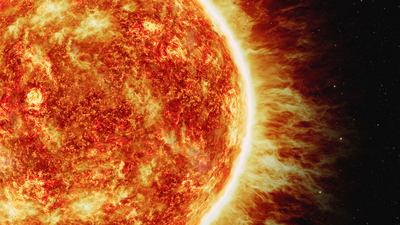
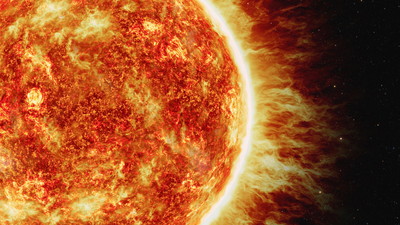
Sunlight helps to sustain life on Earth; as soon as we step outside and tilt our faces up, we feel the warmth as if it were switched on. In reality, that light has lived two very different lives before it touches your skin. The final leg, from the Sun’s visible surface to Earth, takes only about eight minutes across 93 million miles of empty space.But long before that quick sprint, the energy that becomes sunlight spent an unimaginably long time struggling to escape the Sun itself. Deep in the solar core, nuclear fusion creates high-energy radiation. From there, it pushes through layers of incredibly dense plasma, where photons are constantly absorbed, scattered, and re-emitted. Their path is not a straight line but a chaotic “random walk,” more like a drunkard’s stagger than a laser beam.But can you imagine how much time that is, through which the light goes from the Sun’s core to its surface?Let’s dig in to find out.
The light takes lakhs of years to reach from the Sun’s core to its surface
A 1992 study by R. Mitalas and K. R. Sills estimated that this diffusion through the Sun’s interior takes around 170,000 years for today’s Sun!Inside the Sun, matter exists as extremely hot plasma, mostly ionized hydrogen and helium with free electrons. Near the core, this plasma is so dense that radiation cannot simply stream outward the way it does in space.Photons constantly interact with particles through absorption, re-emission, and scattering, so their progress is slow and indirect. In the inner radiative zone, radiation is the main way energy moves outward, while closer to the surface, convection currents takes over. This repeated interaction of the particles with one another turns the process into diffusion rather than travelling in a straight line.
How did the scientists estimate the 170,000-year time taken by light?
Using step lengths derived from a standard solar model, Mitalas and Sills found an average photon step of about 0.090 centimeters, much shorter than earlier simplified estimates.Using this in a “random walk” math model of the photons, they estimated that it takes about 1,70,000 years for energy from the Sun’s core to reach its surface. This result was published in The Astrophysical Journal in 1992. It’s important to see this number as an average, theory-based estimate for how long radiation takes to work its way out, not an exact stopwatch time for one single particle of light.
Photons do not stay intact from core to surface
It is also interesting to know that the visible photon leaving the Sun’s surface is not the same particle created by fusion in the core. Along the way, photons are absorbed, and new ones are emitted with different energies and directions, so the original high-energy radiation is repeatedly redistributed.The spectrum that finally comes out of the Sun’s surface, or the photosphere, is very different from the radiation associated with nuclear reactions deep inside.