








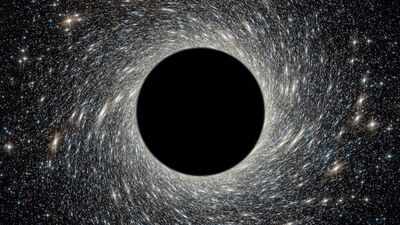
Some stars can make repeated close passes around supermassive black holes, losing part of their material each time while surviving to return again. These encounters produce bursts of light, or flares, that can recur months or even years apart. But astronomers have been puzzled by a pattern seen in some of these systems: each successive flare becomes dimmer. According to a study published in The Astrophysical Journal, researchers now think the answer may lie in how fast the star was spinning before its first encounter with the black hole. The research suggests that an unusually rapid initial spin can reproduce the progressively fading flares seen in some systems.
A star that survives
When a star ventures too close to a supermassive black hole, the difference in the black hole’s gravitational pull across the star can become so extreme that it is torn apart. This is known as a tidal disruption event, or TDE. However, not every encounter results in complete destruction. In some cases, a star loses only part of its outer material while its core survives. The surviving star continues orbiting the black hole and can return for another close pass, losing more material each time. These encounters are known as repeating partial tidal disruption events.The material stripped from the star eventually falls towards the black hole, producing bright flares that astronomers can detect. Yet in several known repeating systems, these flares have become progressively dimmer with each return.
The puzzle of fading flares
A straightforward explanation might be that the star simply loses less material during every subsequent encounter. But earlier simulations suggested that the situation was more complex. As a black hole strips material from a surviving star, its immense gravitational forces can also cause the star to spin faster. This affects how the material removed during later encounters behaves.Even if less material is stripped away, it may fall back towards the black hole more quickly. That could maintain a relatively high peak rate of returning material and produce flares of similar brightness. This prediction did not fully explain why astronomers saw a steady decline in the brightness of some repeating flares. The new study suggests that the answer may lie in the star’s rotation before its first close encounter.
The role of rapid spin
Using simulations, researchers found that stars that were already spinning rapidly behaved differently during repeated encounters with a supermassive black hole. Because these stars were already rotating quickly, the black hole’s tidal forces could not increase their spin as dramatically during later passages. This changed how the stripped material behaved after each encounter.As the star continued losing mass, the amount of material removed could decrease from one passage to the next. At the same time, the timescale over which the material returned towards the black hole remained relatively steady. The result was a declining peak fallback rate, which could lead to progressively dimmer flares. In other words, a star’s unusually rapid rotation before its first encounter may help explain why its repeated flashes become weaker over time.
Where does the rapid spin come from
The study also offers a possible explanation for how these stars became such rapid rotators. The researchers point to the Hills mechanism, a process involving a tightly bound pair of stars that approaches a supermassive black hole. The black hole’s powerful gravity can tear the binary system apart, ejecting one star while capturing the other into a close orbit around it. Before this disruption, the stars may have been tidally locked, meaning their rotation was linked to their orbital motion. In a very close binary, the stars orbit each other rapidly and can therefore also rotate extremely quickly.This process could potentially explain both features needed for repeating partial tidal disruption events: a rapidly spinning star and an orbit that repeatedly brings it dangerously close to a supermassive black hole.
A new explanation
The findings provide a possible solution to one of the more unusual patterns seen in repeating tidal disruption events. Rather than being completely destroyed in a single encounter, some stars can survive repeated close approaches, losing material and producing a flare each time. The new research suggests that the brightness of those flares may depend not only on how much material the black hole strips away but also on a characteristic the star already possessed before its first encounter: its spin. That means the fading flashes seen from some of these extreme systems could offer clues about a star’s earlier history and how it came to orbit so close to a supermassive black hole.For astronomers, these repeatedly disrupted stars provide a rare opportunity to watch the same extreme interaction unfold again and again. And according to the new research, their gradually fading flares may reveal that the key to understanding their behaviour lies in something the stars brought with them from the very beginning, their unusually rapid spin.