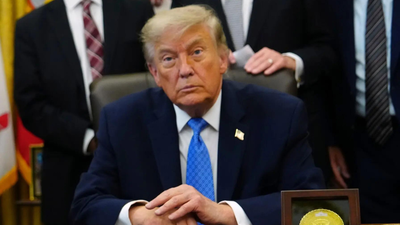







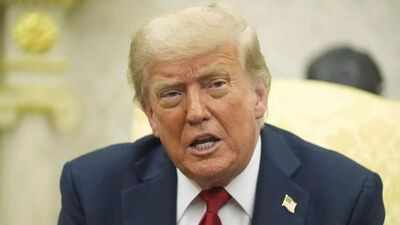
US President Donald Trump took to Truth Social to lambaste Nato over what he claimed was US spending to protect them.His post read, ‘The United States spends more money on Nato than any other country, by far, to protect them, without getting any benefit from so doing: U.S. 999 Billion Dollars, United Kingdom, 90.5 Billion Dollars, France, 66.5 Billion Dollars, Italy, 48.8 Billion Dollars, Poland, 44.3 Billion Dollars. Others, including Germany, are MUCH LOWER. (2014-2025) Ridiculous! President DJT’The figures are real, but the framing is misleading. The $999 billion is cumulative US defense spending, not Nato-specific outlays; the bulk went to Indo-Pacific posture, Middle East operations, homeland defense and nuclear modernisation. The metric Nato actually agreed to in 2014 at Wales is percentage of GDP, and on that measure, the picture has flipped. For the first time since the Wales pledge, all 32 allies are at or above 2 percent of GDP. Nato’s European members and Canada collectively raised defense spending by 20 percent in real terms in 2025 to $574 billion, the largest single-year increase in the alliance’s history. Germany broke its constitutional debt to commit $114 billion. Poland is on track for 5 percent of GDP. Norway now outspends the United States per capita.
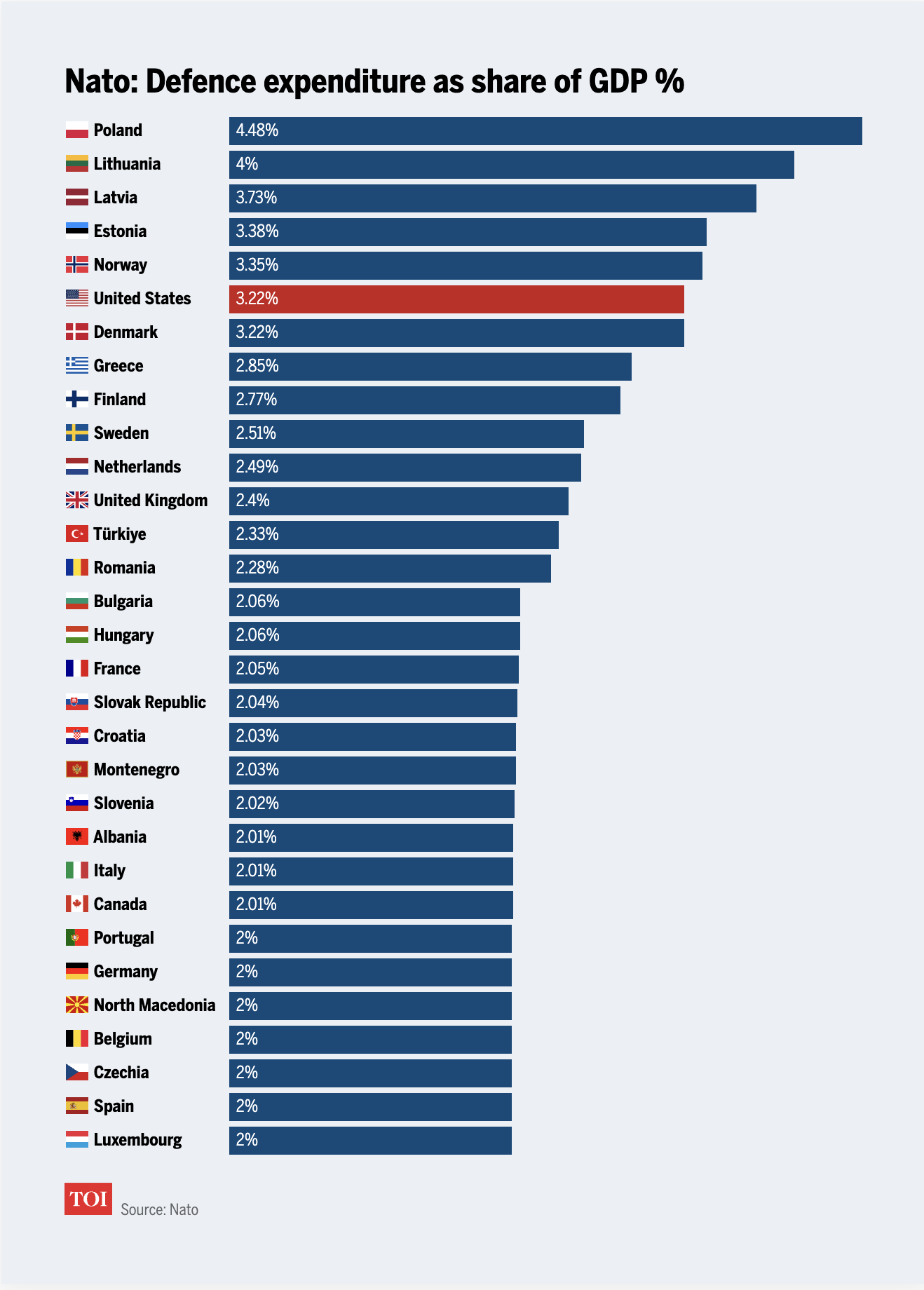
That shift is, in significant part, Trump’s doing. The 2 percent pledge was a dead letter through the Obama and Biden years; it took his political pressure, and Vladimir Putin’s full-scale invasion of Ukraine, to convert it into cash. Robert Gates warned of a “two-tiered alliance” on his way out of the Pentagon in 2011. The Trump administration, across both terms, finally forced the reckoning.The “no benefit” claim is harder to sustain. Trans-Atlantic investment totals roughly $7.4 trillion, annual trade near $2 trillion, and the European defense market, which US firms are aggressively positioning in, could be worth $1.14 trillion by 2035. The US military’s global power projection depends on European bases, Mediterranean access and European logistics. Washington is a shareholder in European security, not a donor.The contradiction is that Trump’s pressure has worked precisely because European leaders concluded he might walk away. Yet his open support for far-right parties across Europe — Alternative for Germany, France’s National Rally, and others — empowers forces that oppose the very policies Washington demands: higher defense spending, de-risking from Chinese technology, and sanctions pressure on Moscow. The 2025 German elections made the AfD the second-largest party. The 2027 French presidential election looms as the next test.