





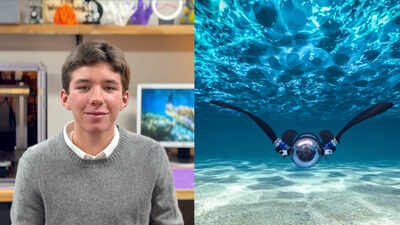
A 16-year-old student from Ontario, Canada has built a robotic sea turtle that swims on its own, dives to a set depth, and uses AI to spot microplastics floating in lakes and oceans. Evan Budz won a $50,000 scholarship for the project at the 2026 Regeneron International Science and Engineering Fair in May, taking home the Gordon E. Moore Award for Positive Outcomes for Future Generations.The machine did not start out impressive. Budz’s first prototype went straight to the bottom of his grandparents’ backyard pool in Canada. He described it sinking like a brick, unable to swim or hold its depth. That was the summer of 2024, and it took roughly 2,000 hours of building to get the robot working, plus another 2,000 on the underwater holographic camera mounted on its shell.
Robot turtle inspired by a snapping turtle on an Ontario camping trip
The idea came from a snapping turtle Budz watched while camping with his family earlier that year. He was struck by how fluid the movement was, and decided to build something that copied it. Turtles turned out to be a practical choice beyond the aesthetics. They are efficient swimmers, which matters for long missions where recharging is not an option. They are also large enough to carry sensors and imaging gear inside the shell, and common enough across aquatic environments that other organisms are not spooked by them.To get the motion right, Budz studied research literature and video, then consulted staff at Ripley’s Aquarium about how green sea turtle flippers actually generate thrust. The flippers were designed in CAD, 3D-printed, and driven by a custom multi-axis servo mechanism that changes the angle of attack between upstroke and downstroke. Computational fluid dynamics simulations refined the shape before any of it hit the water. A spherical dome on the front of the chassis cut drag by 65% compared with a flat endcap.
AI microplastic detection at 10 microns: how the holographic camera works
Depth control runs on a variable ballast system built from a linear servo and two syringes, with a pressure sensor feeding a PID loop. In testing between 20 and 150 cm, it held its target depth within 5 cm. A 9-axis inertial measurement unit handles heading, and the robot completed three-pass and four-pass grid searches in a 4×5 m pool with tracking error under 5 degrees.The detection side is where the AI comes in. Budz started building the holographic imaging system in the summer of 2025, and the hard part was tuning the hardware to resolve particles as small as 10 microns and tell plastic apart from small organisms. By the time ISEF came around, the system was hitting 94% accuracy on that distinction.
Why microplastic lab testing is slow and expensive, and what this robot changes
Budz calls the standard process convoluted. Samples go to a laboratory, analysis takes days even for small batches, and it costs money. None of that works in a remote lake with no lab and no trained technicians nearby. His robot analyses the water where it swims.The Ocean Conservancy estimates 11 million metric tons of plastic waste reach the ocean every year, affecting more than 1,300 marine species. Over 1,700 students competed at this year’s ISEF, which handed out more than $7 million in total. Budz plans to put the scholarship toward a university degree in science or engineering.