







Astronauts heading to Mars will be gone for roughly 400 days, and everything they need has to travel with them or arrive ahead of them. Food is the problem everyone talks about. The bigger one might be the medicine cabinet. More than half the pharmaceuticals stocked on the International Space Station expire within three years—well short of the window a Mars crew would need them for. Expired drugs aren’t just weaker. They can turn toxic.A new study out of the University of California San Diego proposes a workaround that sounds almost absurdly simple: grow the medicine on the way. Researchers cultivated a plant virus with therapeutic properties in a lab setup engineered to mimic microgravity, and the results suggest astronauts could one day farm their own pharmaceuticals mid-flight instead of watching a supply cabinet slowly go bad.
How UC San Diego grew cowpea mosaic virus on tobacco and black-eyed pea plants in simulated microgravity
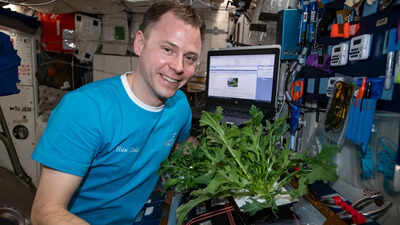
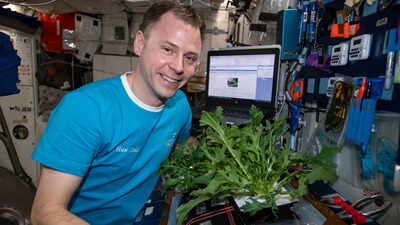
The virus in question is cowpea mosaic virus, or CPMV, which has shown promise in prompting the human immune system to attack cancer cells. The UC San Diego team grew it on two hosts—Nicotiana benthamiana, a cousin of the tobacco plant, and Vigna unguiculata no. 5, better known as the black-eyed pea. The pea plant is the interesting one. It grows the virus and produces edible food, which makes it a two-for-one on a spacecraft where every square centimetre is contested.To simulate weightlessness, the plants sat on a random positioning machine that tumbled in three dimensions, driven by a custom Python script running on a Raspberry Pi. Harvesting was the clever part. Instead of destroying the plant, engineers pulled apoplastic fluid from the leaves using a vacuum, then spun it in a centrifuge to isolate the viral extract. The ISS already has a lab-grade centrifuge on board.
Blood clots, cut-short missions and why medical emergencies on the ISS make Mars pharmaceuticals urgent
They have already happened. A NASA astronaut was found to have a blood clot during a routine ultrasound in 2018 and was put on enoxaparin to prevent a pulmonary embolism. More recently, astronaut Mike Fincke’s medical emergency cut his ISS mission short. Motion sickness, headaches, and urinary tract infections are routine. On Mars, there is no early return flight—only what the crew can grow.