








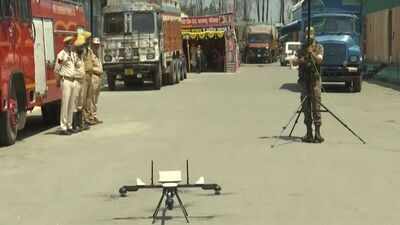
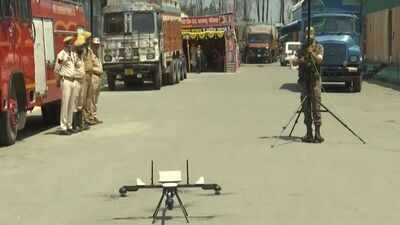
NEW DELHI: As lakhs of Hindu devotees prepare for the annual Amarnath yatra, beginning July 3, the Army has established a comprehensive, technology-driven security shield across the pilgrimage routes in Jammu and Kashmir.The Indian Army, in coordination with the Central Reserve Police Force (CRPF), Jammu and Kashmir Police and other security agencies, has deployed an Integrated Drone Detection and Interceptor System (IDDIS), Low Level Lightweight Radar (LLLR) and L-70 and ZU anti-aircraft guns to detect, track and neutralise potential aerial threats.
Officials said drones are operated regularly by all major security agencies, with sorties conducted during morning and evening hours and additional flights whenever required, in accordance with standard operating procedures (SOPs).Nearly 100 transit camps established along the twin routes (Pahalgam and Baltal) of the Amarnath yatra are under continuous aerial surveillance. Surveillance systems have also been installed on strategically located high ridges to maintain a close watch over vulnerable areas and movement along the routes.Amarnath yatraThe Amarnath yatra is one of Hinduism’s most revered annual pilgrimages, drawing lakhs of devotees from across India and abroad to the sacred Amarnath cave, located at about 3,800 metres in the Himalayas of Jammu and Kashmir.This year the yatra will run from July 3 to August 28, with pilgrims travelling via the traditional 48-km Pahalgam route in Anantnag district and the shorter 14-km Baltal route in Ganderbal district.The yatra has been a high-value target for Pakistan-backed terrorist groups for over two decades, prompting authorities to strengthen security arrangements each year. The deadliest attack came in August 2000, when militants struck multiple sites across Jammu and Kashmir, including the Nunwan base camp near Pahalgam, killing at least 32 people, 21 of them were Amarnath pilgrims. The wider wave of attacks claimed more than 90 lives across the valley.After last year’s Pahalgam attack on tourists, authorities carried out a comprehensive review of security measures across the Union Territory. The incident occured in the same broader region through which thousands of pilgrims travel each year — reinforced concerns over the pilgrimage’s safety.How Army is strengthening securityThe entire anti-drone network is coordinated by Army Air Defence (AAD), which oversees aerial security along the pilgrimage route. As part of the anti-drone architecture, the IDDIS has been redeployed after its successful use during last year’s yatra. Officials said every security agency must obtain prior permission before flying drones to avoid confusion or misidentification.The IDDIS combines soft-kill and hard-kill capabilities to counter hostile unmanned aerial vehicles. Its soft-kill mechanism neutralises drones by jamming their communication and navigation links, while the hard-kill capability can physically destroy rogue drones using laser-based interception.The Low Level Lightweight Radar (LLLR) has been deployed for the first time during the Amarnath yatra. Designed to detect low-flying aerial objects, including drones, the radar operates in two surveillance modes and can identify targets at ranges of 20–50 kilometres.The Army has also deployed L-70 and ZU anti-aircraft guns at key locations along the route. These land-to-air systems provide close-range air defence and can protect areas with a radius of about five kilometres.Alongside the aerial security grid, thousands of personnel from the Indian Army, CRPF, Jammu and Kashmir Police and other central armed police forces have been deployed across the yatra routes.The enhanced measures showcase the Army’s evolving approach to countering both conventional and emerging aerial threats while safeguarding one of India’s most significant annual religious pilgrimages.