








For years, corporate social responsibility (CSR) in education was measured by the number of classrooms built, computers donated, or scholarships awarded. Today, that metric is changing. As India’s education system moves beyond expanding access towards improving learning outcomes, companies are increasingly investing in programmes that strengthen govt schools, train teachers, improve employability and build long-term partnerships with public institutions.The shift comes at a critical moment. India has largely succeeded in getting children into school. According to UDISE+ 2024-25, the country has 14.7 lakh schools, 24.7 crore students, and 1 crore teachers. Rural enrolment among children aged 6-14 has reached 98%, while literacy among those aged seven and above stands at 81%.But the next challenge is ensuring children actually learn. The Annual Status of Education Report (ASER) 2024 shows that among Class III students in govt schools, the proportion able to read a Class II-level text improved from 16.3% in 2022 to 23.4% in 2024, while those able to solve subtraction rose from 20.2% to 27.6%. The gains are encouraging but also underline the distance still to be covered.Govt initiatives such as NIPUN Bharat, Samagra Shiksha, PM SHRI and DIKSHA are attempting to address this challenge through foundational literacy, teacher training, digital learning and school infrastructure. Yet the scale of the task means govts alone cannot do everything. That is where CSR is beginning to play a more strategic role.
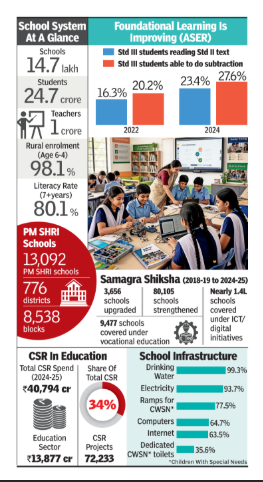
Education has emerged as the single largest recipient of CSR funding in India. According to the latest CSRBOX report, India Inc spent Rs 40,794 crore on CSR during FY2024-25 across more than 72,000 projects. Education accounted for Rs 13,877 crore, or 34% of the total, making it the country’s biggest CSR sector. More significantly, companies are moving away from one-off philanthropy towards multi-year programmes, govt partnerships and data-driven monitoring of outcomes.Bharti Airtel Foundation offers one example of this transition. During FY2024-25, the foundation reported reaching more than 22 lakh students across over 16,000 schools. Its cumulative programmes have impacted 3.7 million students, more than 36,000 schools, and over 3.3 lakh teachers.Rather than focusing solely on infrastructure, its initiatives include teacher support, school transformation, life skills, and community engagement. Its Satya Bharti School Programme operates 164 rural schools across four states, while its Quality Support Programme works with govt schools in 12 states.Another example is Tata STRIVE, which reflects the growing emphasis on employability. In FY2024-25, it directly reached over 4.5 lakh young people and reported cumulative outreach of more than 22.5 lakh beneficiaries through skill development, career guidance, vocational education and entrepreneurship programmes. The focus extends beyond classrooms to ensuring education translates into livelihoods and economic participation.This evolution mirrors the changing needs of India’s education system. While access has improved dramatically, important gaps remain. Nearly 8% of 15-16-year-olds are no longer enrolled in school, with girls recording slightly higher non-enrolment than boys.
Share your thoughts in the comments
Be respectful · TOI community guidelines
Infrastructure has also improved unevenly. Although over 99% of schools have drinking water and nearly 94% have electricity, only about two-thirds have computers and internet access, while just 35.6% have dedicated toilets for children with special needs.These are challenges that require sustained investment rather than isolated interventions. Increasingly, CSR is being used not to substitute public spending but to complement it by piloting new models, supporting teachers, strengthening school systems and helping govts scale successful practices.India has already built one of the world’s largest education systems. The next phase is about making that scale deliver better outcomes. Public investment will remain the foundation, but if current trends continue, CSR could become an important catalyst in helping schools move from expanding access to improving learning, ensuring that every rupee invested delivers lasting change for students, teachers and communities.