









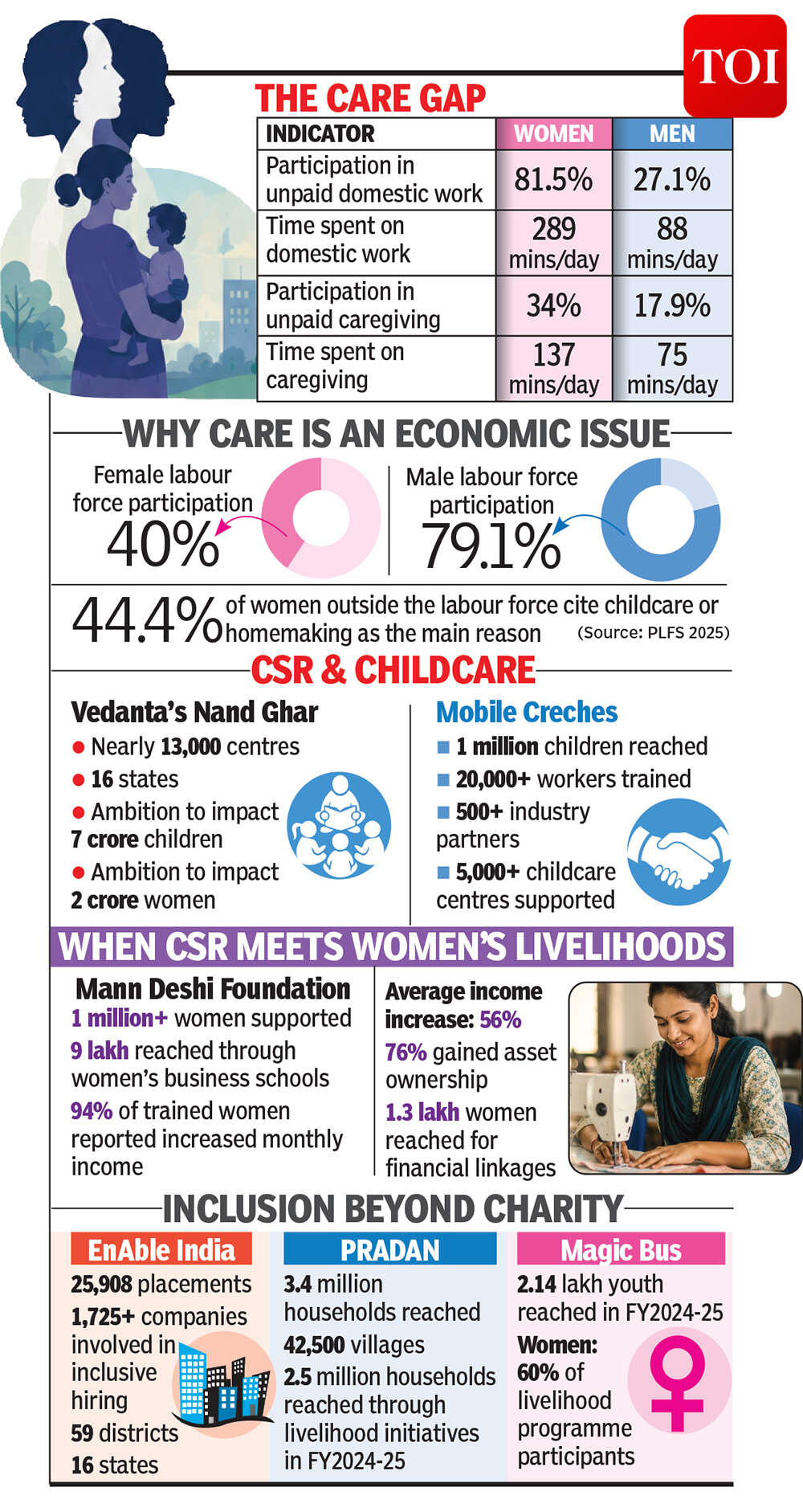
For years, CSR programmes aimed at women have focused on familiar themes such as scholarships, skill training, self-help groups and entrepreneurship. But a more fundamental barrier is increasingly coming into focus: women cannot participate fully in the economy if they carry a disproportionate share of unpaid care work.India’s 2024 Time Use Survey found that 81.5% of women aged six and above participated in unpaid domestic services on a given day, compared with 27.1% of men. Women who participated spent an average of 289 minutes a day on such work, against 88 minutes for men. The gap is also visible in unpaid caregiving, where 34% of women participated compared with 17.9% of men.The economic consequences are clear. India’s female labour force participation rate was 40% in 2025, compared with 79.1% for men. Among women outside the labour force, 44.4% cited childcare or commitments in homemaking as their main reason.This is changing how the private sector can think about inclusion. Instead of asking only how to train or employ more women, CSR programmes can address issues that prevent them from entering and staying in paid work.
Women continue to shoulder a far greater share of unpaid domestic and caregiving work than men, a gap that affects labour-force participation and is increasingly being addressed through childcare, livelihood and inclusion-focused CSR initiatives.
Childcare is an obvious starting point. The govt’s Palna scheme provides day-care facilities for children aged six months to six years, including early stimulation, pre-school education, nutrition and health services. By March 2025, 11,395 Anganwadi-cumcreches were approved across states and UTs, although only 1,761 were operational.This gap creates space for corporate and civil society partnerships. Vedanta’s Nand Ghar initiative is one example. Mobile Creches offers another model, combining childcare with support for children from marginalised communities.The significance of such programmes is that childcare need not be viewed simply as a welfare service. It can be economic infrastructure. If reliable childcare frees up women’s time, the next question is whether that time translates into income, assets and greater economic agency.This is where CSR-backed livelihood programmes can connect with care interventions. Mann Deshi Foundation, for example, reports having supported more than 1 million women, with 9 lakh reached through its women’s business schools since 2012.Its 2024-25 data shows that 94% of trained women reported an increase in monthly average income, with the average rise at 56%, while 76% gained ownership of assets. Its Rural Chamber of Commerce for Women reports reaching 1.3 lakh women for financial linkages, with average monthly income rising from Rs 4,300 to Rs 15,296 afterwards.The lesson for CSR is important. Training women without looking at constraints on their time, access to finance and ability to reach markets can produce limited gains. A more complete intervention connects childcare and care services with skilling, credit, entrepreneurship, market access and asset ownership.The same principle applies to disability inclusion. CSR-led organisations are increasingly helping move disability programmes from charity towards employment and economic participation. Other CSR and civil society partnerships address livelihood barriers among vulnerable groups.
Share your thoughts in the comments
Be respectful · TOI community guidelines
What emerges is a broader understanding of inclusion. Women cannot be empowered simply by giving them a training certificate. A person with a disability cannot be included simply by providing an assistive device. A migrant worker cannot be protected merely by registration on a government portal. Effective social investment must address the barriers between a person and economic participation: care, mobility, documentation, accessibility, skills, credit and employment. For CSR, that represents a shift from funding individual interventions to building pathways. The opportunity is significant.