











Seeing more Argentine ants after putting out pesticide bait may not mean the treatment has failed. A new University of California, Riverside, study found that the chemicals can change the ants’ behaviour, with the response varying depending on the type of insecticide used.Argentine ants are invasive ants commonly found in homes and gardens in Southern California. According to Science X, researchers studied how these ants respond to two insecticides commonly used in ant baits, thiamethoxam and boric acid. Both treatments eventually killed most of the worker ants, but they affected the colonies in very different ways.The research was carried out in the laboratory of UCR entomology professor Dong Hwan Choe and was published in the journal Insects. The researchers found that thiamethoxam caused many affected ants to become unusually active and move outside their nests. Boric acid on the other hand, produced almost the opposite effect, with affected ants stopping their normal foraging and gathering inside the nest.
Inside lab ant colonies
To understand what happened after the ants encountered the insecticides, Choe and his students built transparent colonies in the laboratory. This allowed them to observe the ants both inside their nesting areas and in the spaces where they searched for food.In a healthy Argentine ant colony, the workers are spread through the available nesting space. Most stay inside the nest, where they care for the queen, young ants and other members of the colony. Some workers leave the nest to look for food. After the ants were exposed to thiamethoxam, many more workers became active outside the nest and started roaming around the foraging area.Choe said the researchers had already noticed unusual behaviour during an earlier study. “During a previous study, we saw the ants behaving strangely on the first or second day after introducing a thiamethoxam bait, and it made us wonder if the behavior was related to the toxic effects of the insecticide,” he said. The new research allowed the team to examine this behaviour more closely.
Thiamethoxam sent ants roaming
In the study, thiamethoxam caused many Argentine ant workers to become much more active outside their nest. They wandered through the foraging area before eventually dying.
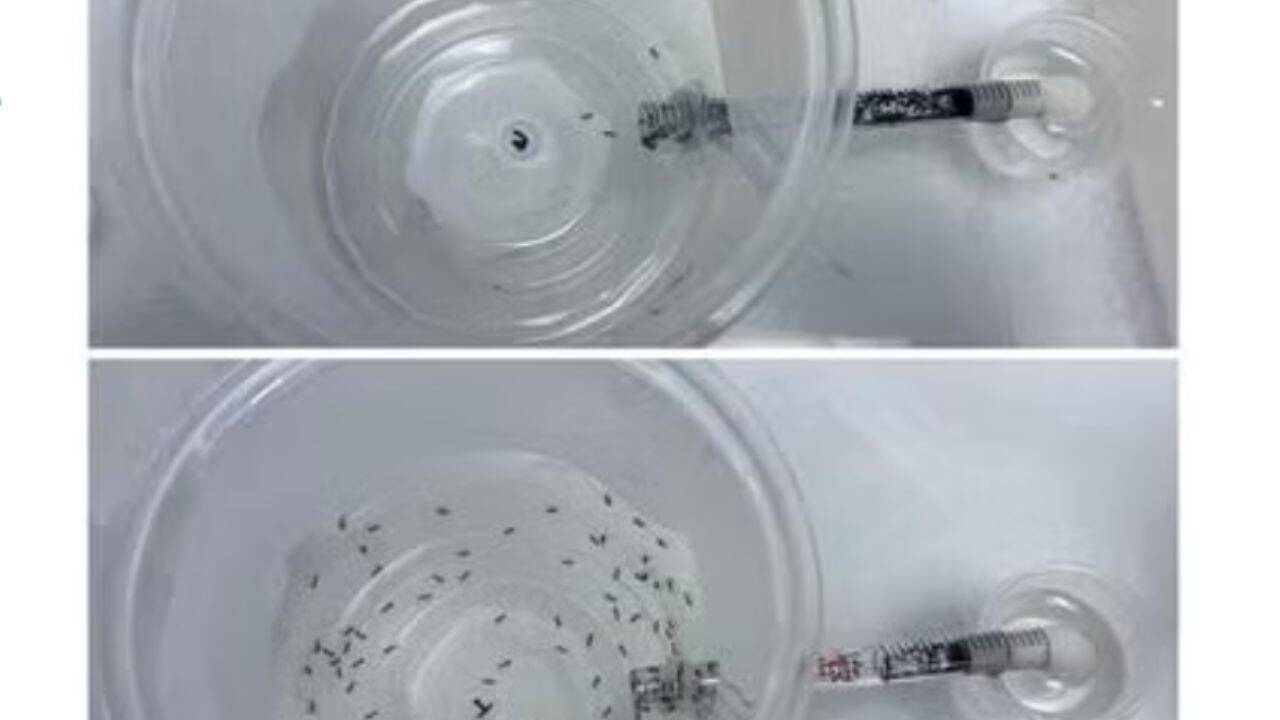
Comparison of ant activity outside the nest before exposure to thiamethoxam (above) and after exposure (below). (UCR photo)
The researchers believe the unusual movement may be linked to the way thiamethoxam affects the nervous system. The chemical mimics some of the effects of nicotine on the insect nervous system. It overstimulates the system and eventually causes paralysis. Thiamethoxam killed all the worker ants in the laboratory colonies within about seven days.That unusual activity can create a misleading impression for people using ant bait. Poisoned ants may wander into places where they are easier to see, including sinks, garages and windowsills. As a result, people may think the infestation is becoming worse when the ants are actually being affected by the treatment.
Boric acid’s opposite effect
Boric acid produced a very different reaction. Instead of sending affected ants outside the nest, it caused them to stop foraging and gather tightly inside the nesting space. The ants were especially likely to gather near sources of water.Boric acid killed about 90% of the worker ants within roughly two weeks. Some people choose it because it is less toxic to non-target insects.In some ants, boric acid is also known to damage the excretory organ, which has an important role in controlling water and removing waste. Choe said these effects could help explain why poisoned ants gather near water.
Single treatment may not be enough
The researchers also found that killing worker ants does not necessarily mean the entire colony has been eliminated. Both insecticides killed most of the workers in the colonies studied. However, the treatments may not always kill the queen. If the queen survives, she can produce a new brood, meaning that the relief provided by a single bait treatment may only be temporary.The study also looked at how the way ants share food could affect the treatment. Workers distribute food throughout the colony, which can reduce the amount of insecticide received by individual ants.Choe said lower doses of thiamethoxam could potentially make the unusual roaming behaviour last longer because the ants would take longer to die.The researchers said there are currently no known cases of insecticide resistance developing in ants, but Argentine ants remain difficult to control.