





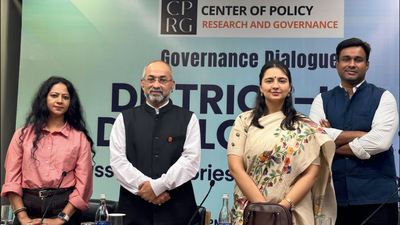
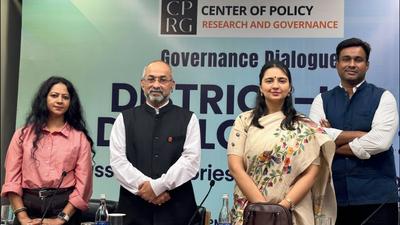
NEW DELHI: The Centre for Policy Research and Governance (CPRG) on Thursday launched its Governance Dialogue series with a multi-stakeholder discussion on “District Led Development: Grassroots Stories, National Outcomes”, bringing together senior bureaucrats, policymakers, industry representatives, academics and media professionals to deliberate on strengthening governance through district-level administration.Addressing the inaugural session at the India International Centre, Tata Institute of Social Sciences (TISS) vice chancellor prof. Badri Narayan stressed the need to bridge the gap between grassroots aspirations and policymaking.“There is a real gap between how grassroots communities articulate their needs and how policy is conceptualised at the top, the language of the margins, the district and the policymaker are often very different, and what is needed is translation between them. That is precisely the gap platforms like CPRG can help bridge, by working from the bottom up,” he said, adding: “Grassroots aspirations are changing rapidly, precisely because government schemes have succeeded in meeting basic necessities, and as development changes people’s lives, it also changes what they aspire to next. The district is where this change must be understood, as it is not merely an administrative unit but a socio-cultural one, closest to the people at the margins.”Delivering the keynote address, joint secretary in the Department of Land Resources, Ministry of Rural Development, Parikipandla Narahari (IAS), said: “There is often a gap between people’s felt needs and their real needs, and closing it is at the heart of good governance. More often than not, the disconnect lies not in policy itself but in implementation, how a policy is carried out on the ground is what matters most for a policymaker. Once implementation is strengthened at the district level, the policies we design naturally come closer to the people they are meant to serve.”Major General K. Narayanan, programme director (Security and Strategic Affairs) at NITI Aayog, who attended as the chief guest, said: “The soul of India lives in its villages, and the district is our basic unit of governance. It is here that policy becomes people, budgets become schools, roads and hospitals, and governance acquires a humane face. For a developed India, policies cannot be made in Delhi alone, they must be shaped from Leh to Lakshadweep. Real innovation happens at the grassroots, and development at that level rests on a few simple principles: trust the district administration, celebrate innovation, measure outcomes rather than expenditure, and learn from one another, for diversity is our strength. In the end, development is about people, and even the smallest village or a single woman entrepreneur can be a force to be reckoned with.”
Do you believe that grassroots participation is essential for effective governance?
3k+ users shared opinion today
5k+ users already voted today
3k+ users shared opinion today
The first panel discussion featured Jalna District Collector Ashima Mittal, Indian Oil Corporation Executive Director (CSR) Bibhuti Ranjan Pradhan and The Economic Times Senior Editor Anubhuti Vishnoi. Panellists highlighted community participation in district development, the use of artificial intelligence in policymaking, and the need to move beyond infrastructure indicators towards quality-of-life outcomes.
Share your thoughts in the comments
Be respectful · TOI community guidelines
The second panel, comprising NTPC Executive Director (HR) Premlata, National Centre for Disease Control Deputy Director Dr. Avinash Sunthlia, CNN-News18 Senior Associate Editor Madhuparna Das and CPRG Senior Resident Fellow Banuchandra, discussed integrating government schemes, strengthening grassroots healthcare systems and promoting citizen participation in governance.CPRG said the Governance Dialogue series will continue in the coming months to foster sustained engagement among government, industry, academia and the media on public policy and governance issues.