








Japan’s famous Shinkansen bullet trains are celebrated for their speed, efficiency and punctuality, but they once faced an unexpected engineering challenge. Every time the high-speed trains emerged from tunnels, they produced a powerful “tunnel boom,” a loud pressure wave that disturbed nearby communities and limited how fast the trains could travel. Engineers searched for years for a solution, but the breakthrough came from an unlikely source: a small bird. Eiji Nakatsu, the chief engineer of the 500 Series Shinkansen and an enthusiastic birdwatcher, noticed that kingfishers dive from air into water at high speed with barely a splash. That simple observation inspired a redesign that transformed one of the world’s fastest trains into one of its quietest and most efficient examples of biomimicry.
Why Japan’s bullet trains created a loud boom every time they left a tunnel
As Japan pushed its high-speed rail network to even greater speeds during the 1990s, engineers encountered a new aerodynamic problem.When a Shinkansen entered a tunnel at high speed, it behaved like a piston, compressing the air trapped inside the tunnel. The pressure wave travelled ahead of the train and burst out of the tunnel exit, creating a loud explosion-like sound known as a tunnel boom. According to the BBC, the noise was powerful enough to disturb residents living near tunnel exits and became a major obstacle to increasing train speeds. Because much of Japan’s railway network passes through mountainous terrain filled with tunnels, solving the problem became essential for the future of the Shinkansen.
How a birdwatching engineer found the answer in a kingfisher
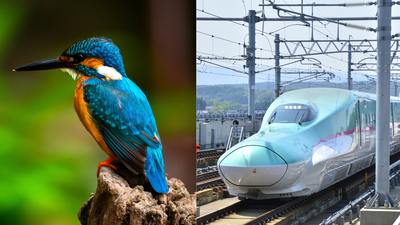
The breakthrough came from Eiji Nakatsu, an engineer at JR West who also happened to be an avid birdwatcher.While watching kingfishers hunt, Nakatsu noticed that the birds plunge from low-density air into water, which is about 800 times denser, without producing a noticeable splash. He realised the bird’s long, narrow and streamlined beak allowed it to transition smoothly between two very different environments by reducing sudden pressure changes. Nakatsu wondered whether the same principle could help a train move from open air into the confined space of a tunnel without creating a damaging pressure wave.That insight became one of the world’s best-known examples of biomimicry, designing technology by learning from nature.
How the kingfisher-inspired design made the Shinkansen faster and quieter
Engineers redesigned the nose of the 500 Series Shinkansen to resemble the kingfisher’s elongated beak.Instead of abruptly pushing air into the tunnel, the new streamlined nose gradually displaced it, dramatically reducing the pressure wave responsible for the tunnel boom.The redesign produced benefits beyond noise reduction. The improved aerodynamics allowed the train to travel around 10% faster while using approximately 15% less electricity, making it both quieter and more energy efficient. The modified design also enabled the train to comply with Japan’s strict environmental noise standards.Today, the elongated nose has become one of the defining visual features of modern Shinkansen trains.
The bullet train became one of the world’s best examples of biomimicry
The kingfisher was not the only bird that inspired improvements to the Shinkansen.According to Eiji Nakatsu, engineers also studied the silent flight of owls to redesign the train’s pantograph, the structure that connects the train to overhead power lines. By borrowing features from owl feathers, they reduced aerodynamic noise generated while travelling at high speed. Together, these innovations demonstrated how closely observing nature can solve complex engineering challenges that conventional approaches struggle to overcome.
A small bird changed the future of high-speed rail
The Shinkansen’s transformation has become a landmark case study in engineering, proving that some of the most effective technological solutions already exist in nature.What began as a frustrating noise problem ultimately led engineers to rethink how trains interact with the air around them. Inspired by the effortless dive of a kingfisher, they created a bullet train that was not only quieter, but also faster and more energy efficient.More than three decades later, the story continues to be taught around the world as a powerful reminder that innovation sometimes begins not in a laboratory, but by simply paying closer attention to the natural world.