









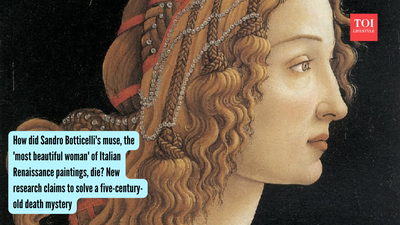
Simonetta Vespucci, or more popularly known as Sandro Botticelli’s muse, the woman whose face defined the Italian Renaissance, is among those faces from history that are spotted so frequently that they feel like they’ve always been with us, even though we know almost nothing about the person behind them.Her likeness has floated across one of the most reproduced paintings on Earth for more than five centuries, printed on postcards, tote bags, and textbook covers, long after anyone remembers her name.But did you know there has been a long-held mystery as to how she died so young, in her twenties, at the height of her fame in Renaissance Florence?For hundreds of years, her death remained an ‘unsolved case’, and this time another researcher has come up to investigate the cause of her passing.Let’s dig in to find out!
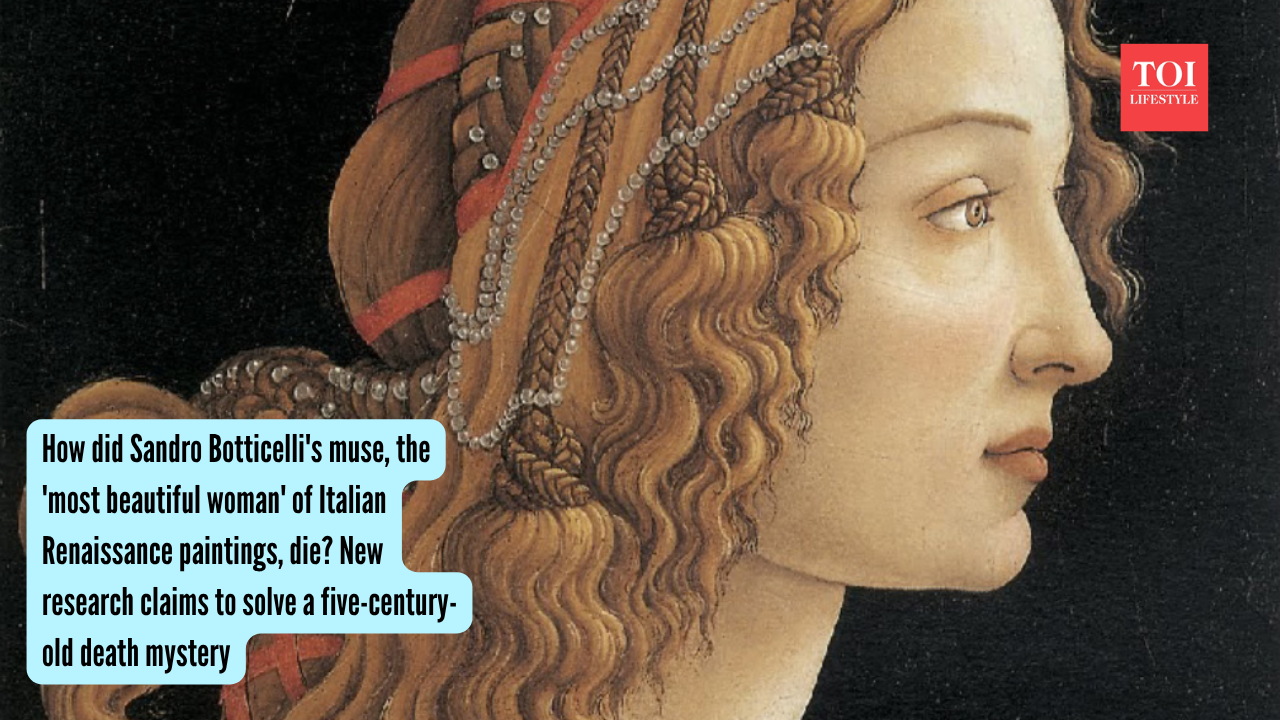
Simonetta Vespucci (Photo: Accademia Europea di firenze)
Who was Simonetta Vespucci, the face of Italian Renaissance paintings
Simonetta Vespucci is popularly known as the most celebrated beauty of Renaissance Florence. Born Simonetta Cattaneo in Genoa in 1453, she married into the Vespucci family.She moved to Florence with her husband Marco around 1469 and, despite being only 16 years old, immediately earned an image as the most beautiful woman in Italy as artists flocked to capture her visage.She then became a favourite subject of painter Sandro Botticelli, who immortalised her face in “The Birth of Venus” and at least four other works. She died suddenly in 1476, at just 23, and for centuries her death was blamed on tuberculosis, which killed countless people in that era, and so it seemed a reasonable explanation at the time, and nobody had much reason to question it.
But a new study now has a different reason for her death
The explanation that has been held for a long time is now being challenged. A team from Queen Mary University of London, the Università Campus Bio-Medico di Roma, and the University of California published a new study in the journal Endocrinology, Diabetes & Metabolism, arguing that Simonetta didn’t die of tuberculosis at all, but from complications of a pituitary tumour.This goes back to a work that the same researchers first proposed back in 2019, when they suggested she may have had a pituitary adenoma, a tumour on the small hormone-regulating gland at the base of the brain.To test the theory, the researchers ran a facial recognition algorithm across five portraits of Simonetta, tracking subtle changes in her jaw, forehead, and facial tissue over time.The changes they found were consistent with excess growth hormone and prolactin, hormones that can change the shape of facial features over time, subtly and, in rare cases, trigger lactation in someone who was never pregnant, something researchers say appears in Botticelli’s “Allegorical Portrait of a Woman.”
The team also studied their historical letters
Beyond the paintings, the team also went back to evaluating historical letters. Correspondence between Piero Vespucci, her father-in-law, and Lorenzo de’ Medici, her patron and political ruler of Florence, describes Simonetta collapsing during a ball shortly before her death, after which she reportedly suffered severe headaches, hallucinations, vomiting, and fever while confined to a darkened room.
So, what was it that she actually died of?
According to Queen Mary University of London, first author Domiziana Nardelli, Ear Nose and Throat (ENT) Resident at the Università Campus Bio-Medico di Roma, said these were all symptoms of a rapidly expanding pituitary tumour.Researchers believe a separate documented incident, an alleged assault by Alfonso II of Aragon, the first King of Aragon, may also have contributed to sudden bleeding or swelling in the tumour.Together, all these episodes signal pituitary tumour apoplexy, a medical emergency where a tumour bleeds or swells rapidly, triggering the kind of fast, catastrophic decline historical accounts describe, rather than the slower physical deterioration typically associated with tuberculosis.
An imperfect but compelling case
No one is claiming certainty here. Diagnosing an illness five and a half centuries after the fact, based on paintings and letters, will always leave room for doubt, and Pozzilli’s team has acknowledged as much.Still, the layered evidence, from facial changes in Botticelli’s canvases to eyewitness accounts of her final days, has been enough to convince several researchers that tuberculosis may never have been the real culprit at all, and that one of art history’s most enduring beauties may be remembered for the wrong reason.