








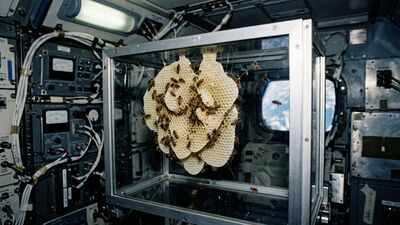
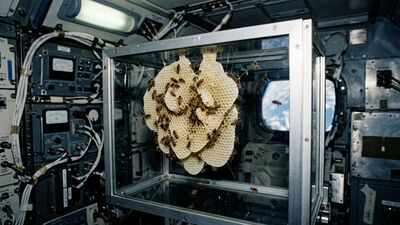
A small box of honeybees once became an unusual passenger aboard the space shuttle Discovery. In 1984, Nasa sent thousands of honeybees into orbit to see how they would behave when gravity was no longer guiding their movements. The experiment was less about honey and more about a basic piece of bee life: building a comb. Honeybees normally construct their wax cells inside a hive, using gravity and contact with one another as part of the process. In space, those familiar cues disappeared. The bees had to work in microgravity, where there was no obvious floor, ceiling or natural direction. They eventually produced about 31 square inches of honeycomb, offering researchers a glimpse of how a colony might adapt beyond Earth.
Why Nasa sent bees into space
Honeybees are closely tied to agriculture because they pollinate many of the plants people depend on for food. That made them interesting to Nasa as a possible part of future space-based agriculture. If humans were ever to grow crops away from Earth for long periods, pollinating insects could become useful members of that system.As reported by Center for Humans & Nature, the 1984 experiment was not Nasa’s first attempt to understand how insects cope with spaceflight. An earlier mission in 1982 had carried 14 honeybees, along with other insects, to examine how microgravity affected their movement. Those adult bees struggled with flight and tended to cling to surfaces instead.The later mission gave scientists a much larger group to observe. About 3,300 to 3,400 honeybees travelled aboard Discovery, where they were placed in a specially designed enclosure that allowed astronauts to watch their behaviour.
How bees built honeycomb without gravity
For a honeybee colony, a comb is much more than a storage structure. The wax cells become places for honey and pollen, as well as a nursery for developing young bees.Workers produce wax from glands on the underside of their bodies. They then handle the tiny flakes with their legs and jaws, gradually shaping them into the familiar six-sided cells. On Earth, a colony can build a new comb surprisingly quickly when food is plentiful and extra storage space is needed.The space bees had the same basic instincts, but the environment was completely different.Without gravity, the insects could not rely on the usual sense of which way was up. Their first attempts at comb construction reflected that problem. Instead of producing the neatly oriented structures familiar from a terrestrial hive, they created sections at different angles.
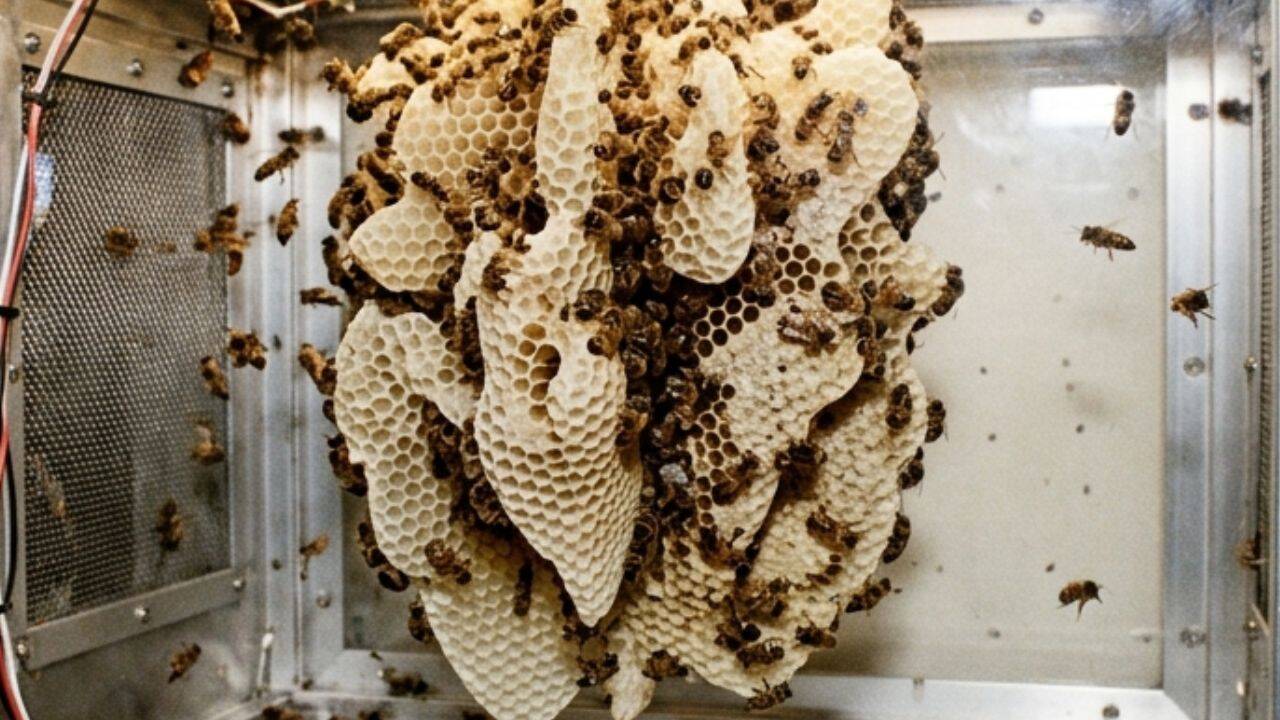
The bees adapted and built 31 square inches of comb
As the mission continued, the honeybees became better at moving around in microgravity. They learned to fly in the unusual environment and began building comb inside the enclosure, both on the provided foundation and away from it.The colony ultimately produced roughly 31 square inches of honeycomb. That amount may seem modest compared with the huge structures a healthy colony can create on Earth, but the experiment demonstrated that the bees could perform one of their most important tasks without normal gravity.Their comb was not perfectly aligned. The different angles suggested that orientation remained difficult, but the bees were still able to produce a functioning structure. They also behaved in other familiar ways. Dead bees were removed from the colony, just as they would be on Earth. The insects continued with many of the routines that keep a colony functioning even though their surroundings were anything but ordinary.
The queen bee laid 35 eggs during the space mission
As reported by NASA Life Sciences Portal (NLSP), the experiment produced another intriguing result. During the mission, the queen laid 35 eggs.The eggs did not hatch after the bees returned to Earth, and the reason was not established. That meant the mission demonstrated that bees could build, comb and reproduce some colony behaviours in microgravity, but it did not show that a complete bee population could successfully reproduce in space. The number of bees involved may also have mattered.A normal beekeeper’s starter package can contain around 8,000 to 10,000 bees. During the height of summer, a strong colony can reach tens of thousands more. The bees sent into orbit therefore represented only a fraction of the workforce found in an established hive.
A honeybee colony depends on teamwork
The small space colony also highlights how much of a hive’s activity depends on numbers. Bees do not simply build comb individually and then live alongside one another. Different workers perform different jobs as they age. Younger workers tend to care for developing broods, while older bees increasingly take on tasks outside the hive, including foraging.Comb construction itself requires a coordinated workforce. Bees produce wax, shape it, extend existing structures and respond to the changing needs of the colony. When nectar is plentiful and a colony needs additional storage, hundreds or thousands of workers can contribute to the process.
Why comb matters so much to bees
Honeycomb is one of the most recognisable structures in the natural world, but its production is expensive for the insects that make it.Bees need energy and suitable conditions to produce wax. They are more likely to construct fresh comb when there is a reason to do so, such as a growing population or an increase in available nectar that needs to be stored.Once built, the comb serves several purposes. Honey and pollen occupy some cells, while others become part of the brood nest. A queen can lay eggs in the cells, and nurse bees care for the developing larvae until they are sealed inside their wax coverings.The structure is therefore both storage space and living space. A hive without comb is essentially an empty framework. The bees turn it into a colony.
What the space experiment revealed about bee teamwork
Watching thousands of insects work together in a weightless environment also offered a useful reminder about how colonies operate. A hive is not simply a collection of independent bees. Its success comes from thousands of small actions that fit together.The bees aboard Discovery were able to compensate for the absence of gravity to a surprising degree. They adjusted their movements, found ways to construct comb and continued caring for the colony. Yet their work also showed where the limits of that adaptation might lie.The resulting honeycomb was not perfectly formed, and the queen’s eggs did not develop successfully after the flight.For a short mission, the bees accomplished a great deal. But building a hive is a collective undertaking, and a functioning colony requires far more than a handful of insects completing individual tasks.