







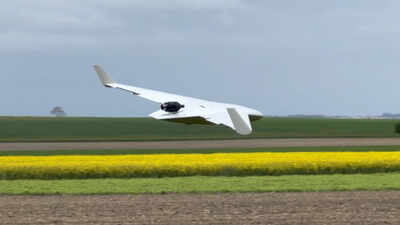
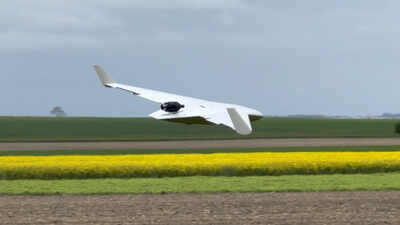
NEW DELHI: One of the lingering memories of Operation Sindoor was the loitering munition that crashed into a Pakistani HQ-9 air defence system at the defunct Walton Airport in the heart of Pakistan’s cultural capital Lahore. This was the first use of the Harpy drone by the Indian armed forces in anger, cementing the role of these systems as a dependable weapon for India. India has expanded the procurement of these systems since the kinetic phase of the conflict ended on May 10 last year.Now, Indian firm SMPP has signed an agreement with European consortium KNDS to manufacture their loitering munitions in India. Loitering munitions developed by KNDS include systems such as Colibri and Larinae offer endurance ranging from 45 minutes to three hours, enabling operators to observe and strike with accuracy even in contested environments. The Veloce and Rodeur platforms, will be manufactured in India with SMPP. These systems will provide hybrid GNSS–INS guidance and fire‑and‑forget functionality, ideal for neutralising high‑value threats. KNDS’s Mataris family, including the MX‑10, MT10, and ground‑based MTO‑T, integrates loitering munitions into artillery, armoured vehicles and urban combat scenarios.
SMPP too has developed its own series of loitering munitions. The firm has recently delivered 106 of its Agnivegsystems to the Indian Army. This system has demonstrated its precision strike capability and has also showcased an operational range of nearly 180 km, while operating in a heavily-jammed environment.
Loitering Munitions: seeking out the target
Loitering munitions, often called suicide drones, combine the features of a drone and a precision-guided weapon. Unlike conventional missiles, which fly directly to their targets, these systems can orbit over a target area for extended periods, providing real-time surveillance before striking. This dual capability allows commanders to identify, track, and engage targets with high accuracy, while at the same time reducing collateral damage. Their portability and relatively low cost make them attractive for modern militaries, especially in asymmetric warfare.Loitering munitions are particularly effective against mobile or time-sensitive targets such as air defense systems, artillery, or armored vehicles. They are also important to hit what are called targets of opportunity, or targets that reveal themselves only briefly. Recent conflicts have highlighted their disruptive potential, with small units able to deliver strategic effects.