









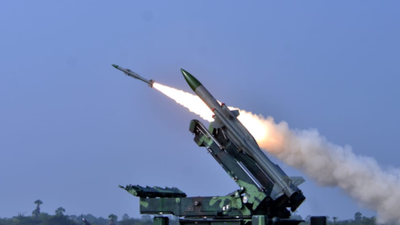
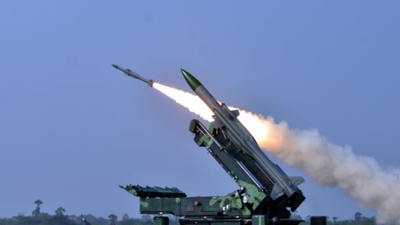
Ongoing conflicts in West Asia and Ukraine continue to reinforce the importance of an effective air defence umbrella. As both these conflicts expand in terms of time with no end in sight, the need for effective air defences is only growing. This at a time when the notion of short swift wars has severely been dented, the dawn of non-contact warfare has become a reality, as nations are increasingly using stand-off weapons to degrade or destroy the adversary’s combat capability, as was demonstrated by India during Operation Sindoor, leading to the Pakistanis to sue for peace thereby concluding the conflict.The conflict also demonstrated how Indian air defences could withstand the Pakistani onslaught. This demonstrated that both the sword and the shield worked effectively in India’s favour and exposed the shortcomings of Pakistan’s defences. What makes this surprising is that just a little over a decade earlier, General VK Singh, when he was the army chief had warned about the obsolesce of the army’s air defences, which are often the first line of defence. Many of these systems such as the L-70 air defence guns, modified domestically proved their effectiveness during the 88-hour conflict.The scope of air defence has also increased tremendously. These weapons, in different classes, are tasked to engage different types of aircraft and missiles. These targets could range from peering satellites and ballistic missiles in space to cheap drones flying very close to the ground. This list of threats also includes, fighters, helicopters, cruise missiles and force multipliers flying much further behind the frontlines.
Airspace is going to be contested during a conflict, with both sides fighting to control it in time and space, we have to ensure that the control of the air stays with us. Air defence systems are a very important aspect of this endeavour. Air defence was initially seen as point defence, but now it has evolved to exert control over much larger areas, encompassing different aspects ranging from low level to destroying ballistic missiles in space. This aspect of aerial warfare is no longer a defensive element, but has evolved to be an offensive one.
Air Vice Marshal Anil Golani, former DG Centre for Air Power Studies
India’s maturing air defence environment
India’s domestic air defence journey is now maturing, with various components being developed domestically. Air defence is made up of different components that can be put in three separate categories, which are sensors, this includes radars and electro-optronics. The second component of this system is a Command, Control, Communications, Computers, and Intelligence (C4I) component where the sensor inputs come together in order to form a comprehensive air-battle picture, such as the Integrated Air Command and Control System (IACCS). The third and the last component of this system are the air defence weapons platforms, this could include air defence guns, Surface-to-Air Missiles (SAMs). Most air defence subunits such as air defence gun detachments and SAM batteries also have this chain built in their organic structure.
The Indian air defence umbrella in the making
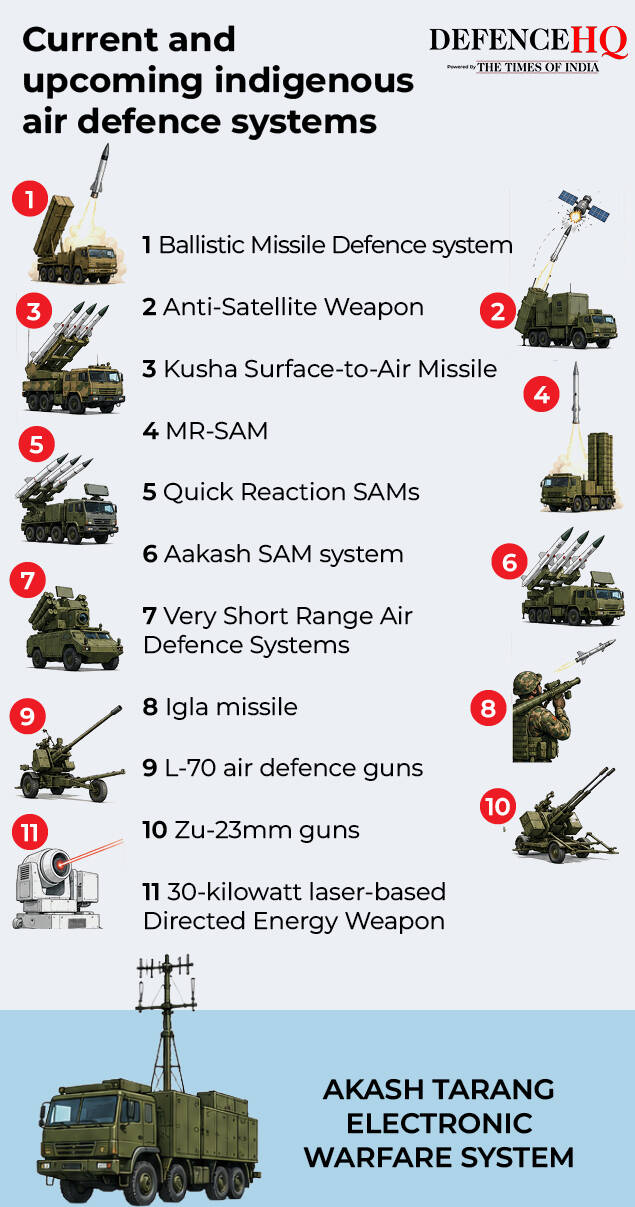
Three months after the conclusion of the kinetic phase of Operation Sindoor, from the ramparts of the Red Fort, during his independence day speech, Prime Minister Narendra Modi announced the formation of a comprehensive air defence shield, terming it Mission Sudarshan Chakra. The project is similar to other such programmes such as the under development US Golden Dome and Israel’s operational Iron Dome. India has to have a robust system that can defend a vast landmass with multiple high-value targets spread across thousands of kilometres. This requires not just interceptors but a seamless integration of radars, sensors, command centres and directed-energy systems. The building blocks of the system are already ready.The Ballistic Missile Defence (BMD) programme has validated interceptors in both the endo-atmospheric (within) and exo-atmospheric(outside) domains. This was validated the Phase-II of this critical shield and have demonstrated their ability to destroy ballistic missiles of the 5,000-km range class. On June 10 and 11, 2026, the Defence Research and Development Organisation (DRDO) conducted three consecutive flight tests, demonstrating multi-layered defence against long-range ballistic missiles. The challenge remains creating a seamless network that can detect, track and neutralise these threats under saturation conditions. Both Iran and Russia have used such saturation ballistic missile attacks recently in order to overcome defences. Capability needs to be developed in which a saturation ballistic missile attack can be countered effectively.With the recent successful test of the Kusha SAM, the country is well on its way to have a domestically developed weapon that is similar to the S-400. Project Kusha, being developed in three long-range variants, is designed as an indigenous counterpart to the Russian S-400 system, which proved its effectiveness during Operation Sindoor, by taking out a Pakistani aircraft deep behind enemy lines. Project Kusha will have three variants based on the missile, these variants are M1 with a 150 km range, M2 with 250 km, and M3 with 350 km—will form the backbone of India’s long-range air defence. Kusha is being built as a scalable and integrated platform into a national shield, capable of engaging stealth fighters, cruise missiles and drones.The MR-SAM, jointly developed with Israel and produced by Bharat Dynamics Limited, a key element of India’s air defence arsenal also proved its combat effectiveness, reportedly intercepting a Pakistani Fatah-II ballistic weapon over Sirsa during Operation Sindoor. This missile has a range of 70km.The domestically developed Akash missile system too proved its effectiveness in neutralising aerial threats during Operation Sindoor. Newer variants of the Aakash missile, such as the Akash-1S and Akash Prime are further improvements to the baseline missile. Akash-NG, a newer more capable variant of the missile too is under development that will ensure that the missile will be able to hit targets at longer ranges of up to 80km, a remarkable improvement of over 30km.The DRDO, now is in the final stages of developing the very short range air defence system, often thought of as the last line of defence for the protection of vital areas and points, this adds depth to the layered defence architecture. Currently the army and the air force use the Russian Igla missile in this role. Other systems, based on electronic warfare, such as, Akash Tarang, which jam drone frequencies, provide a non-kinetic options to neutralise threats.Directed-energy weapons, once seen more fiction than science, are now part of the air defence quiver. Lasers offer near-instant precision engagement, sustainable against swarms of drones or incoming projectiles at a fraction of the cost when compared to missile based interceptors. The DRDO has demonstrated a 30-kilowatt laser system that can take down flying projectiles.Air defence guns, which were thought of as obsolete weapons in the modern air defence scenario, are brought back to relevancy by the advent of drones in modern warfare. The army has modified its air defence weapons in recent years, adding additional capabilities in the form of electro-optronics that help the air defence gunners passively acquire targets. These systems are cost effective at destroying drones and are more effective against swarm drones than missile based defences.Air defence is no longer a supportive asset but central to national security. The emphasis is on integration—bringing together interceptors, radars, sensors, command centres and directed-energy systems into a seamless shield. The Gulf wars demonstrated that even the best systems can fail under saturation attacks. India’s challenge is to build resilience into its umbrella, ensuring that its skies remain secure against the full spectrum of threats.This transformation demands a whole-of-nation approach which will include industry, research institutions and the armed forces working in tandem. From quick reaction SAMs to long-range interceptors, from electronic warfare to lasers, India is building a layered architecture that will redefine how the country defends its air space. The Sudarshan Chakra project, once operationalised, will force adversaries to readjust their strategic calculus.