









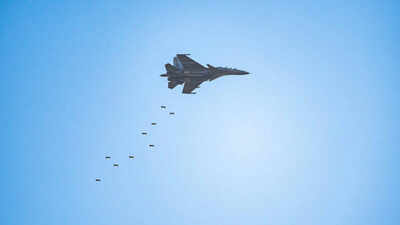
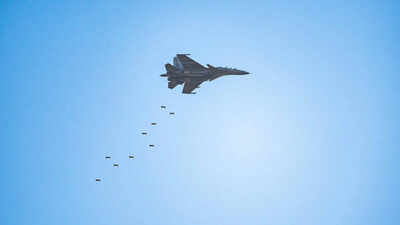
The Indian Air Force, lives by its guiding principle of infallible, impervious and precise, as coined by the air force chief. The IAF has built a reputation on accurate delivery of ordnance. A very good example of this level of precision weapons delivery was showcased during the 1971 war to liberate Bangladesh. During that conflict the IAF very accurately dropped bombs on the Kurmitola and Tejgaon air bases in Dhaka, ensuring that the Pakistani air force’s 14 squadron stayed grounded. Later in the conflict, the IAF accurately struck the residence of the governor, forcing him to resign. These air strikes demonstrated the pinpoint accuracy showcased by the IAF, before the dawn of precision weapons in the IAF.The character of aerial bombing has undergone a profound transformation in the past decade, with precision emerging as the defining constant. The United States and Israel hve demonstrated this, as they are dismantling Iran’s military capability. The IAF has had a slower pace of inductions, beginning with improvisation during the Kargil War and advancing through Balakot to the multi-platform strikes of Operation Sindoor in 2025.The Kargil conflict in 1999 marked the genuine start of precision bombing in Indian military aviation. Fighting at the super high altitudes of Kargil, the Indian Air Force improvised laser designation and satellite-aided targeting, integrating Israeli Litening pods with Mirage 2000s. The payoff was decisive and telling as was witnessed during the battle for Tiger Hill. The IAF, had been working to activate laser guided weapons on its aircraft and compressed the process to have the bomb operational in days, instead of months.Two decades later, in 2019, in retribution to the Pahalgam terror attack, India launched Operation Bandar – more commonly known as the Balakot air strikes, showcased a more deliberate capability. Twelve Mirage 2000s struck a Jaish-e-Mohammed camp at Balakot using Israeli SPICE-2000 precision munitions, achieving pinpoint accuracy. It was the first time since 1971 that the IAF had struck inside Pakistan’s mainland, signalling a qualitative escalation in reach and intent.Operation Sindoor in May 2025 demonstrated an entirely precision weapon campaign. The IAF struck nine locations, including JeM and LeT headquarters, using a coordinated mix of BrahMos cruise missiles from Su-30MKIs, SCALP-EG missiles and HAMMER bombs from Rafales. Brahmos and SCALP cruise missiles were employed in a single stand-off strike, marking Brahmos’ combat debut and SCALP’s first use in a state-on-state engagement. This was a networked, multi-platform package capable of hitting targets deep inside Pakistan with negligible collateral damage.The IAF has built a strong set of precision weapons that can hit targets hundreds of kilometers away. These weapons range from the famed Brahmos missile, used by the air force to hit targets deep inside Pakistan during Operation Sindoor, to laser guided bombs, which have a much smaller glide range. The air force has inducted weapons such as the Israeli Rampage and Crystal Maze weapons with a range of 250 km. The air force also uses bombs such as the French Hammer with a range of 70 km and the Israeli Spice, which can extend a bomb’s range to a 100 km.At the same time, the DRDO too is developing stand-off weapons. These include the Smart Anti-Airfield Weapon (SAAW) with a range of 100km, as well as the Gaurav glide bomb with the same stated range. Recently the Tactical Advanced Range Augmentation (TARA) a guidance kit which can extend the range of a dumb bomb to 30km. The air force has demonstrated that in every strike it is infallible, impervious and precise.