









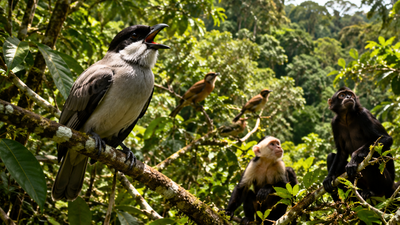
The Amazon rainforest is never truly quiet, and its endless chorus of chirps, whistles and calls may carry far more information than humans realise. Scientists studying wildlife in the Peruvian Amazon have uncovered a remarkable network in which birds and primates pick up information from one another’s alarm calls when predators appear. Small canopy birds emerged as especially important sources of these warnings, helping alert a wider community that includes other birds and monkeys. Published in Current Biology in April 2026, the research reveals an invisible “information highway” operating above the forest floor, where listening to the right neighbour at the right moment could provide animals with crucial information about approaching danger.
In the Amazon, a bird sounds the alarm and a monkey gets the message
High in the dense Amazon canopy, a tiny bird catches sight of something dangerous moving between the trees: a raptor hunting overhead. It immediately sounds the alarm. The sharp warning travels through the leaves, catching the attention of other birds nearby. A nunbird hears the commotion and responds, helping the warning travel farther through the forest.Not far away, a monkey may be moving through the branches, completely unaware of the predator hidden beyond the thick foliage. It never saw the raptor. It did not need to. The sudden chorus of alarm calls has already told it that something is wrong, giving it a chance to become alert and react before danger comes closer.The bird is not necessarily trying to save the monkey. Instead, the monkey is eavesdropping on nature’s warning system, extracting life-saving information from the calls of another species. Scientists call this heterospecific eavesdropping, and across the Amazon canopy, interactions like these help create an invisible network through which news of danger can travel from one animal to another.Study authors Ettore Camerlenghi and Ari E. Martínez captured the idea vividly when describing the ecosystem:“Suspended above our heads is a vast ecosystem where animals constantly listen to one another.”They explained that this eavesdropping network can spread critical information within seconds, connecting animals that may be very different but face overlapping threats.
Scientists brought trained raptors into the rainforest
Studying such an invisible communication system presented researchers with a challenge. Natural predator encounters are unpredictable, making it difficult to observe exactly how a warning begins and where it travels.During an expedition to a remote area of the Peruvian Amazon, researchers worked with a falconer and used trained raptors to trigger alarm calls from birds and primates. They recorded those calls and later played combinations of urgent alarms back into the forest, monitoring how the surrounding animal community responded.The experiments included calls from animals of different sizes and from different levels of the forest, allowing the scientists to investigate which groups were most effective at triggering further warnings.The study, titled Small canopy species drive information highways about predators in an Amazonian rainforest, was authored by Camerlenghi, Eliseo Parra, Jorge Novoa, Daniel T. Blumstein, José M. Ponciano and Martínez. It appeared in Current Biology on 20 April 2026.
Tiny birds emerged as the forest’s most influential messengers
The researchers divided animals into four broad groups according to body size and whether they lived mainly in the canopy or understory.One group stood out: small canopy birds weighing less than 100 grams.Their alarm calls were the only category found to significantly increase the likelihood that other species would propagate the warning. These small canopy birds were also more likely than the other groups to continue passing alarm information onwards.As the study concluded, these birds “play a central role in propagating risk-related information” across the community.For a tiny bird, such vigilance makes ecological sense. Raptors pose a serious threat, so rapidly detecting danger can be a matter of survival. But that vigilance also creates information that neighbouring animals can exploit.
Nunbirds became the super-relays of the canopy
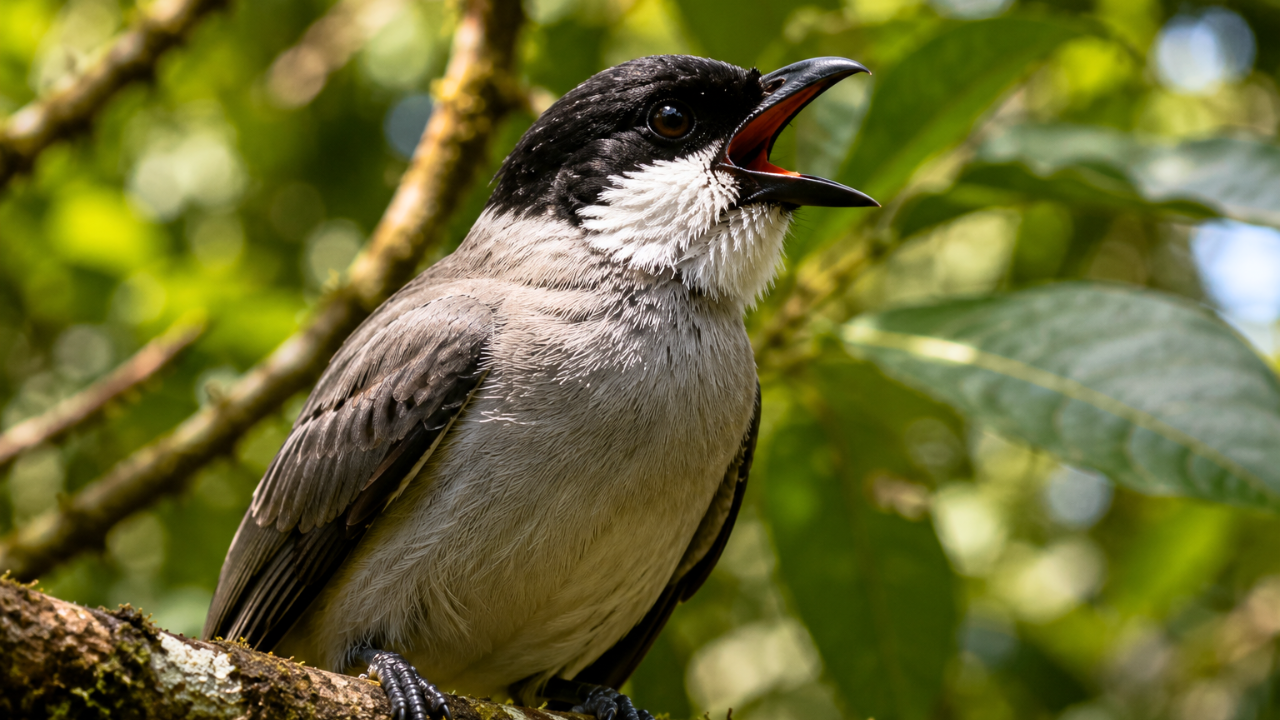
Two species were particularly influential: the black-fronted nunbird (Monasa nigrifrons) and white-fronted nunbird (Monasa morphoeus).Together, Monasa nunbirds accounted for 56% of the recorded alarm-propagation events among small canopy species.Their importance lies in their ability to respond to warnings generated by others. The study found that Monasa species disproportionately propagated alarm signals after hearing calls from both birds and primates.In effect, they behave like important junctions along the forest’s information highway. A warning that begins elsewhere reaches them, they respond, and their calls make that information available to another set of listeners.The scientists described the overall result as a functional “acoustic highway” in the canopy.
Monkeys are part of the conversation too
The network does not stop at the boundary between birds and mammals.Researchers observed that larger animals, including capuchin and spider monkeys, sometimes responded to alarm information as well. The study concluded that alarm propagation across taxonomic groups, including between birds and primates, may be a common feature of these risk-information networks.Animals do not need to understand another species in the way humans understand spoken language. They simply need to recognise that a particular sound or behavioural response reliably accompanies danger.That ability is especially valuable in a rainforest.Thick leaves, tangled branches and towering vegetation can make it impossible to see everything happening nearby. Listening to other species effectively extends an animal’s awareness beyond what its own eyes can detect.
Sometimes danger makes the Amazon suddenly fall silent
Perhaps the most fascinating discovery was that information about predators did not always produce more noise.Sometimes it produced silence.Researchers monitored vocal activity from 138 bird and primate species during their trials. Small canopy birds showed a significant reduction in vocal activity after alarm calls were played.As Camerlenghi and Martínez explained, bird sounds are normally associated with behaviours such as attracting mates and defending territories. But their research suggests that changes in that activity can also reveal something very different.They described these changes as possible pulses of a “soundscape of fear”.Imagine a canopy alive with whistles, chirps and calls. An alarm suddenly rings out. Then much of that chorus disappears.For animals listening nearby, the absence of ordinary sound may itself become meaningful.As the researchers put it, “A sudden silence may mean a raptor is gliding somewhere above the canopy.”
Why the canopy makes the perfect ‘information highway’
The Amazon is not one uniform habitat. It is a vast vertical ecosystem.Near the ground lies the shaded understory. Far above it stretches the canopy, a living roof containing an extraordinary concentration of biodiversity.The study focused on a lowland Amazonian community containing more than 370 bird species and 10 primate species, illustrating the sheer number of potential listeners and information sources living within the same ecosystem.In such a crowded environment, animals constantly generate clues.An alarm from another tree, birds abruptly fleeing or a sudden disappearance of normal calls can reveal that something has changed.The research found a clear difference between forest layers. Warnings involving small canopy birds were particularly influential, while alarm calls from understory species were much less likely to spread through further alarm calling.This led the researchers to compare the canopy to a “fiber-optic network through which animals rapidly share signals of danger.”
Shared enemies create unlikely connections
Why should a monkey pay attention to a bird?The answer may be surprisingly simple: they can share threats.A predator moving through the canopy may pose risks to several species. An animal that learns to recognise another species’ reliable warning therefore gains information without having to discover the danger itself.No conscious alliance is required.If responding to another animal’s alarm provides even a few additional seconds to become vigilant, hide or move away, listening can offer a significant survival advantage.The result is an ecosystem where animals with very different evolutionary histories can become temporarily connected by the one piece of information that matters to all of them: something dangerous is nearby.It is not a secret universal animal languageThe researchers found that not every type of alarm was equally effective. When they compared different combinations of calls, no particular combination consistently drove warning propagation across the entire community.Instead, the strongest pattern came from one ecological group: small canopy birds.Some animals therefore appear to be much more influential information sources than others.The network is less like a group conversation and more like an interconnected neighbourhood in which certain residents are especially reliable at noticing trouble and causing others to react.
The study reveals an invisible side of biodiversity
Ecologists traditionally examine ecosystems through visible relationships: predators eating prey, bees pollinating flowers or animals dispersing seeds.This research highlights another resource moving through nature: information.As the study states, interspecies communication networks can shape animal communities because species both produce alarm calls and eavesdrop on others, allowing information to cross ecological niches and taxonomic boundaries.That raises intriguing questions for future conservation research. If particularly influential informants disappear, could other animals lose valuable sources of information about danger?The study did not test whether removing particular species would disrupt or collapse the network, so such an effect cannot yet be claimed. But the findings reveal that biodiversity may support relationships far less visible than conventional food webs.
The rainforest is constantly listening
To human ears, the Amazon canopy may sound like an overwhelming chorus of whistles, chirps and cries. For its inhabitants, that soundscape can contain information with immediate consequences.A tiny bird spots danger. An alarm rings through the leaves. Another animal responds. Some birds fall silent. Elsewhere, a primate may react to information circulating through the same ecological community.No wires connect them, and no single species controls the system.Yet information moves.As Camerlenghi and Martínez wrote, animals above our heads are “constantly listen[ing] to one another”, creating a network capable of moving crucial warnings remarkably quickly. Their findings reveal a hidden dimension of rainforest life: beneath what sounds to us like a chaotic chorus lies an intricate web of listeners, informants and relays.In the Amazon, survival may depend not only on keeping your eyes on the sky, but also on knowing when your neighbours have suddenly stopped singing.