









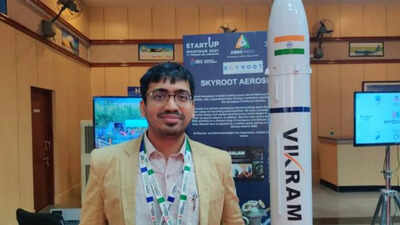
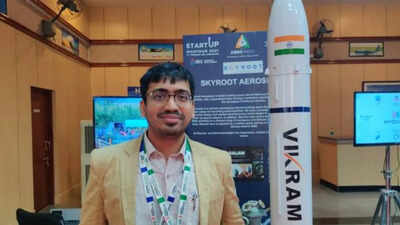
Once, he scored just 51 marks in Maths. Today, he is the founder of India’s largest private rocket factory and the man behind the country’s first privately built rocket launched into space.Pawan Kumar Chandana was born in 1991 in Hyderabad, Telangana. He grew up in a middle-class family with a natural curiosity for machines, but his academic record has little hope of the trajectory ahead. As a school student, he once scored just 51 marks in mathematics, a subject that would later become the anchor of his dreams. However, his “ambitious” father never gave up on him and instead enrolled him on IIT JEE coaching. It was during this time while preparing for his entrance exam that Chandana improved academically and fell in love with both maths and science.In 2007, he joined IIT Kharagpur after clearing the examination on his first attempt. He proceeded to get a dual BTech-MTech degree in Mechanical Engineering. While many of his classmates went on to chase high-paying jobs and international careers, he was fascinated by rockets and space.
From ISRO to entrepreneurship
In 2012, Chandana joined ISRO as a scientist right from the campus. Despite a low-paying salary, he dreamt of retiring from there since he loved the work he did at the Vikram Sarabhai Space Centre in Thiruvananthapuram. He worked there for nearly six years, contributing to the GSLV Mk-III (India’s heaviest launch vehicle), the S-200 solid booster for GSLV Mk-II, and served as deputy project manager for ISRO’s Small Satellite Launch Vehicle (SSLV). In 2016, he won an internal innovation award at ISRO.However, an idea sparked in his mind, that of building a space-tech company from India, at a time when private rocket development was neither allowed nor funded.Five years later, in 2018, he quit ISRO, a move that many would call a risky one. Despite having no background in business or a professional network, he began his journey, seeking funding by cold-messaging Mukesh Bansal, founder of Myntra, CureFit and NuRX on LinkedIn.To his surprise, Bansal, a fellow IIT Kharagpur alumnus believed in his vision and invested $1.5 million in his venture. However, soon came the COVID-19 pandemic, which made raising a Series A funding a struggle. Just when his dream felt impossible, the founders of renewable energy giant Greenko stepped in with financial backing. In June 2018, Chandana and Naga Bharath Daka, a fellow ISRO engineer and IIT Bombay alumnus co-founded Skyroot Aerospace in Hyderabad.In July 2020, his company became the first private Indian company to test a rocket engine, the Raman-1, a cryogenic engine named after Nobel laureate C.V. Raman. 2021, when the Indian government opened the space sector to private companies, Chandana’s Skyroot Aerospace, became the first private player to sign an MoU with ISRO and later raised India’s largest DeepTech cheque of $51 million.
India’s first private rocket company
On November 18, 2022, his company launched Vikram S, India’s first privately developed suborbital rocket, which lifted off from ISRO’s Sriharikota launch range, and reached an altitude of 90km. It was a part of Mission Prarambh, meaning beginning in Sanskrit.Soon, Indian Prime Minister Narendra Modi inaugurated his company’s new facility as his team grew to nearly 1,000 employees and established the country’s largest private rocket manufacturing unit.On May 7, 2026, Skyroot Aerospace made history for the second time. The company raised $60 million in a funding round co-led by Sherpalo Ventures the firm of Ram Shriram, the first external investor in Google and GIC, Singapore’s sovereign wealth fund. Today, Chandana’s company is valued at around $1.1 billion and is preparing for the next milestone, Vikram-1, the orbital launch scheduled for 2026.If successful, Skyroot could join the top five private companies globally capable of regular orbital missions. The USA has SpaceX, New Zealand has Rocket Lab and India has Skyroot.