







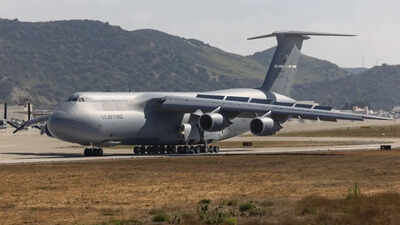
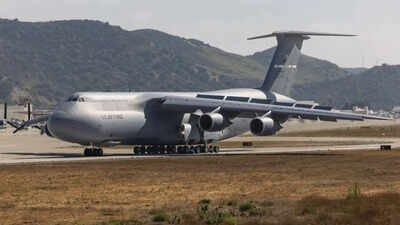
The United States Air Force has taken the first formal step towards developing its next-generation strategic airlifter, releasing a Request for Information (RFI) for the Next Generation Airlifter (NGAL) programme. The future aircraft is expected to eventually supplement and replace portions of the ageing Boeing C-17 Globemaster III and Lockheed Martin C-5M Super Galaxy fleets that currently underpin America’s global air mobility capability.Issued by the Air Force Life Cycle Management Center’s Mobility Aircraft Directorate, the RFI provides the clearest indication yet of how the USAF envisions future military logistics operations. Rather than seeking a simple replacement for existing transport aircraft, the service appears to be pursuing a platform capable of operating across highly contested battlefields while delivering greater range, survivability, connectivity, efficiency and operational flexibility than current systems.The document suggests that future strategic airlift requirements are being shaped by lessons from recent conflicts as well as preparations for potential future wars against peer adversaries equipped with advanced missile systems, integrated air defence networks and sophisticated cyber warfare capabilities.Baseline requirementsThe Air Force has established three key baseline requirements for the NGAL programme:
- Wingspan of less than 223 feet (68 metres)
- Ability to carry at least 160,000 pounds (72.5 tonnes) of payload
- Capability to transport that payload at least 2,500 nautical miles (4,630 km) without aerial refuelling
In addition to these core specifications, the service is seeking information on aircraft dimensions, engine configuration, propulsion technologies, development maturity and operational concepts.The RFI also places significant emphasis on the ability to operate from semi-prepared and austere airfields, highlighting a major shift in how the Air Force expects future logistics missions to be conducted.Semi-prepared runways typically possess some level of construction and infrastructure but do not meet the standards of fully developed military airbases. Austere runways are even more basic, often located in remote, forward-operating or expeditionary environments with minimal support facilities.Preparing for future contested environmentsThe current US strategic airlift fleet consists primarily of approximately 222 Boeing C-17 Globemaster III aircraft and 52 Lockheed Martin C-5M Super Galaxy transport aircraft.The C-17 serves as the backbone of America’s global air mobility network, transporting troops, equipment and humanitarian aid worldwide. The larger C-5M fleet provides heavy-lift capability for oversized cargo, including armoured vehicles, helicopters and other outsized military equipment.However, military planners increasingly believe future conflicts may unfold in environments where traditional large airbases are vulnerable to long-range precision strikes.Potential adversaries such as China and Russia have invested heavily in anti-access and area-denial capabilities, including ballistic missiles, cruise missiles, long-range air-defence systems and electronic warfare assets designed to disrupt military logistics networks.As a result, the USAF is seeking a transport aircraft capable of surviving and operating in far more contested conditions than those faced by current airlift fleets.Focus on survivability and remote operationsOne of the most notable aspects of the NGAL RFI is its emphasis on survivability and independent operations at remote locations.The Air Force has specifically asked industry participants to explain how their aircraft designs would reduce dependence on Material Handling Equipment (MHE) at forward-operating or austere locations.This requirement reflects a desire for aircraft that can rapidly load and unload cargo even when traditional logistics infrastructure is unavailable.Such capabilities would allow forces to deploy and sustain operations from dispersed locations while reducing vulnerability to enemy missile attacks.The requirement closely aligns with the Air Force’s Agile Combat Employment (ACE) concept, which focuses on dispersing aircraft across multiple locations rather than concentrating them at a small number of large bases.Under ACE, military units are expected to operate from remote airfields using smaller support teams and reduced infrastructure, making logistics aircraft a critical enabler of future combat operations.A transport aircraft capable of independently handling cargo and operating from damaged or minimally prepared runways would significantly improve operational flexibility in such scenarios.Lessons from recent operationsThe growing emphasis on austere operations is also informed by recent operational experiences.Modern military operations have increasingly highlighted the importance of rapidly deploying personnel, equipment and special operations forces into remote or contested regions where infrastructure may be damaged, unavailable or under threat.The USAF’s recent combat and contingency operations have demonstrated the value of aircraft capable of accessing difficult locations while maintaining high sortie rates and operational tempo.Military planners view this capability as particularly important in future conflicts where established airbases may be targeted early in a campaign, forcing forces to disperse and operate from alternative locations.More than a replacement programmeWhile the NGAL programme will eventually replace portions of the C-17 and C-5M fleets, the RFI makes clear that the initiative is about far more than acquiring a new cargo aircraft.The requirements reveal an Air Force preparing for a future characterised by dispersed operations, persistent missile threats and contested logistics networks.Future airlifters are expected not only to transport troops and equipment but also to function as resilient nodes within a larger military network, capable of sustaining operations across vast distances while remaining effective under hostile conditions.By emphasising austere operations, survivability, rapid logistics and reduced dependence on support infrastructure, the Air Force appears to be defining a new generation of strategic airlift capability designed specifically for great-power competition.The NGAL programme remains in its early stages, and the RFI is intended to gather industry feedback before formal acquisition decisions are made. However, the document offers an important glimpse into how the USAF expects future conflicts to be fought and the critical role logistics aircraft will play in sustaining military operations across some of the world’s most contested environments.