









Every autumn, forests across large parts of the Northern Hemisphere begin a transformation that attracts travellers, photographers and scientists alike. Hillsides that spent months wrapped in summer green gradually shift towards yellow, orange and red as trees prepare for winter. Predicting exactly when those colours will appear has never been straightforward. Forecasts have often relied on broad indicators of vegetation health rather than direct observations of the pigments responsible for autumn’s display.A NASA satellite is now offering a more detailed view. Data collected by the agency’s Plankton, Aerosol, Cloud, Ocean Ecosystem mission, better known as PACE, is allowing scientists to observe subtle pigment changes inside leaves from space. Instead of simply tracking how green vegetation appears, researchers can now monitor the chemical signals that drive seasonal colour change itself.
NASA’s PACE satellite is tracking autumn’s colour transformation across Earth from space
For decades, satellites have monitored vegetation by measuring chlorophyll, the pigment plants use during photosynthesis. Chlorophyll is responsible for the green appearance of leaves and has long served as a useful indicator of plant activity.That approach works well for tracking broad patterns of growth, but it reveals only part of the story. Leaves contain other pigments that become increasingly important as seasons change. Some help plants manage excess sunlight, while others protect against environmental stress.According to NASA’s PACE Mission, the satellite’s observations make it possible to distinguish between several pigment groups rather than focusing solely on chlorophyll. The result is a far richer picture of vegetation conditions than previous global monitoring systems could provide.
How NASA’s PACE satellite sees autumn colours in greater detail
PACE was primarily designed to study oceans and the atmosphere. Its Ocean Colour Instrument, however, records information across roughly 100 wavelengths of visible and near-infrared light, giving it capabilities that extend well beyond marine science.This type of observation is known as hyperspectral imaging. Instead of collecting a handful of broad colour bands, the instrument separates reflected sunlight into many narrow wavelengths. Small differences in leaf chemistry that would normally remain hidden become visible in the data.NASA’s Leaf Year: Seeing Plants in Hyperspectral Colour highlights how researchers have used these measurements to identify three major pigment groups in vegetation: chlorophyll, carotenoids and anthocyanins. Together, they provide a more complete view of plant condition throughout the year.
How NASA visualises autumn colours across continents
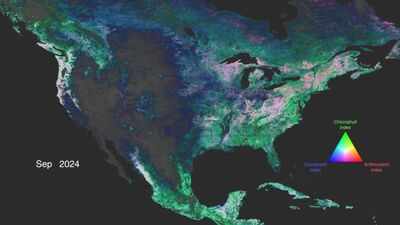
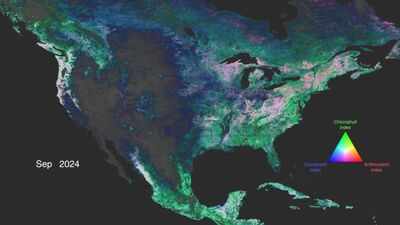
Anyone who has watched trees change colour in autumn has already seen these pigments at work.Chlorophyll dominates throughout spring and summer, masking many of the colours beneath it. As daylight hours shorten and growing conditions change, chlorophyll production slows, and existing stores begin to break down.Carotenoids, which produce yellow and orange tones, are present in leaves for much of the year but are often concealed by stronger green pigments. Anthocyanins create red shades and can develop as leaves transition towards dormancy.NASA visualisations built from PACE observations show these pigments shifting across continents through the seasons. In the agency’s Global Views of PACE Land Vegetation Data project, changing concentrations of chlorophyll, carotenoids and anthocyanins reveal the progression of spring growth, summer activity and autumn colour across different ecosystems.
How NASA tracked a year of seasonal change from space
The first year of PACE observations covered the period from March 2024 to March 2025. During that time, scientists tracked vegetation patterns across forests, grasslands and agricultural regions around the world.The data captured the northward movement of spring as new leaves emerged across the Northern Hemisphere. Later in the year, pigment signals reflected the onset of autumn and the gradual retreat of growing seasons. Regions with evergreen forests displayed relatively stable patterns, while deciduous landscapes showed much larger seasonal swings.Because PACE revisits the globe every one to two days, these changes can be monitored repeatedly rather than through occasional snapshots. That regular coverage offers a level of continuity that has been difficult to achieve at a global scale.
How NASA’s PACE satellite could help monitor forests and crops
The ability to identify individual pigments has implications that extend beyond autumn scenery.Different pigment balances can indicate how plants respond to changing environmental conditions. Shifts in colour chemistry may appear before visible signs of stress become obvious on the ground. Researchers believe this could improve monitoring of forests, crops and ecosystems facing drought, heat or other pressures.Fred Huemmrich of the University of Maryland, Baltimore County, who contributed to the PACE research programme, has described the new observations as opening an entirely different perspective on vegetation characteristics that were previously difficult to measure from orbit.The information could eventually contribute to forest management, agricultural monitoring and studies examining how ecosystems respond to a changing climate.