









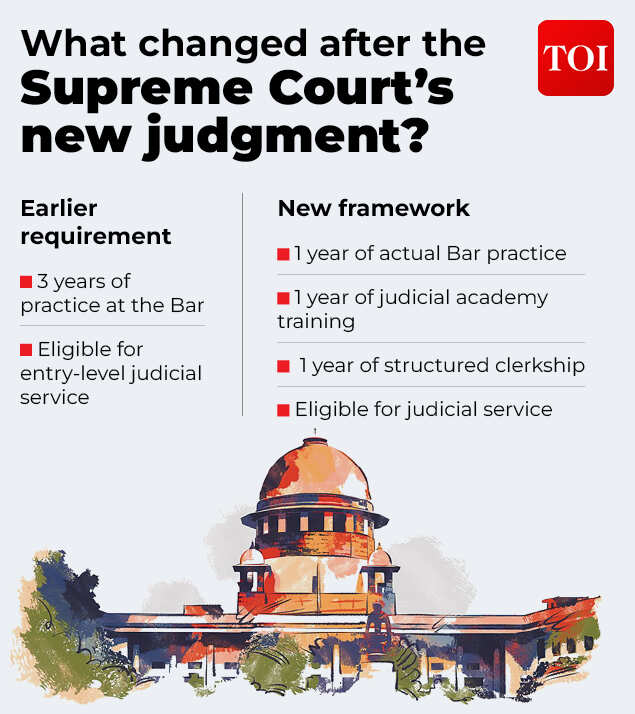
NEW DELHI: Is one year of practice at the Bar enough to prepare a lawyer for the responsibilities of a judicial officer? The Supreme Court‘s decision to reduce the practice requirement for entry-level judicial service from three years to one has triggered a debate over whether courtroom experience can be adequately supplemented by judicial academy training and clerkship.Former Uttarakhand high court Chief Justice Vipin Sanghi said three years of practice should remain mandatory, arguing that young lawyers need time to develop courtroom maturity and learn how to deal with lawyers and litigants. Supreme Court lawyer Vivek Narayan Sharma and Advocate Siddharth Sijoria of Clavius Legal, however, said the new framework could work if the training and clerkship are rigorous and properly implemented.Why has the practice requirement become a point of debate?The new framework provides for one year of actual practice, followed by one year of judicial academy training and one year of structured clerkship. This has raised a larger question: should courtroom readiness be measured by the number of years a lawyer has spent practising, or by the quality of practical training received before taking up judicial responsibilities?Vivek Narayan Sharma, Senior Advocate, Supreme Court, said the change should not simply be viewed as replacing three years of professional preparation with one year. He said the framework instead restructures the preparation period and aims to combine actual Bar experience with judicial training and clerkship.Advocate Sijoria of Clavius Legal also said completing a particular number of years at the Bar does not automatically make someone ready for judicial office. The important question, he said, is whether a candidate has acquired a practical understanding of how courts function, how litigants and lawyers conduct themselves, how evidence and arguments unfold and how proceedings are managed.
=
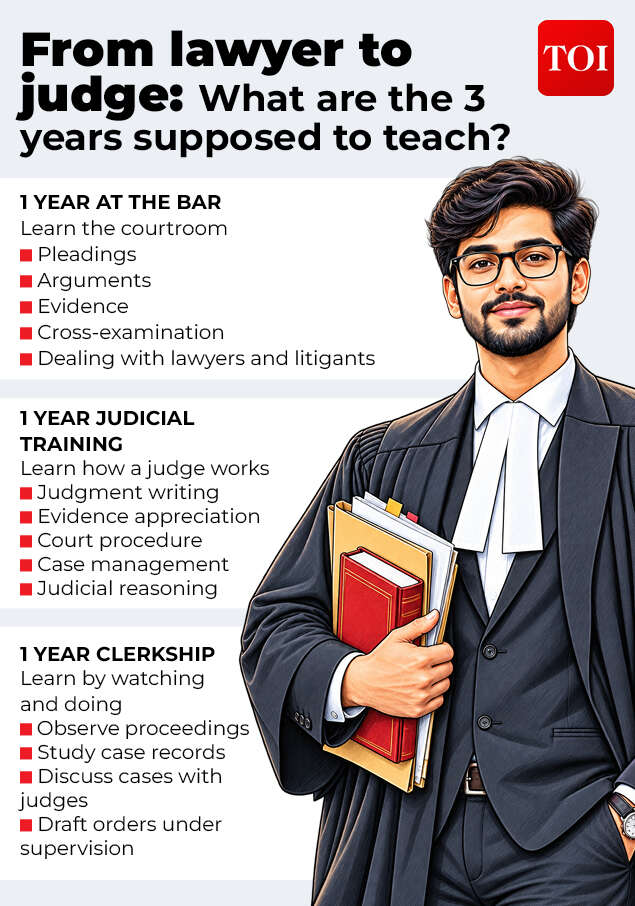
Is one year of practice enough for a future judge?Justice Sanghi strongly disagreed with the reduction, saying one year of practice would provide only limited experience to most young lawyers.He explained that newly enrolled advocates generally begin by assisting senior lawyers and may not get sufficient opportunities to independently argue cases. They also need time to understand the mannerisms and conduct expected from advocates and judges.“In my view one year practice as an Advocate is not sufficient experience for appointment as a judicial officer,” Justice Sanghi said.According to Justice Sanghi, some were rude or arrogant and did not know how to conduct court proceedings.“As a judge of the Delhi high court and subsequently as the Chief Justice of Uttarakhand high court, I received several complaints, including from senior and experienced members of the bar – particularly those practicing in the District courts, that the newly appointed judges who were recruited directly to the judicial service without any experience, were – at times, rude, arrogant and did not know how to conduct the court. They lacked the humility and the etiquette to hold a court with proper decorum, which is essential for any meaningful debate or argument in a court,” he added.Justice Sanghi also stressed that judging is a mature responsibility because judicial officers exercise considerable power and wide discretion. A person entering judicial service at around 24 years of age, he observed, may not always have the maturity required to handle that responsibility.What does a lawyer learn during the first three years?The lawyers agreed that practical experience at the Bar is important, although they differed on how many years should be mandatory.Advocate Sijoria said the first few years of practice teach lawyers things that are difficult to learn from books or examinations. These include understanding pleadings, procedural applications, evidence, cross-examination, arguments and practical case management.Repeated courtroom exposure also teaches lawyers how facts emerge during contested proceedings, how witnesses behave under pressure and how procedural decisions can affect the outcome of a case.A lawyer’s exposure, however, varies considerably. Sijoria pointed out that many young lawyers spend much of their first year researching, drafting, filing cases and assisting seniors. They may attend several hearings without actually getting opportunities to independently conduct evidence or cross-examine witnesses.Sharma highlighted another aspect of Bar experience — understanding the human consequences of legal disputes. Lawyers learn to read files beyond pleadings, identify relevant facts, understand evidence, deal with registries, seek urgent relief and negotiate settlements.“The Bar teaches you to see the person behind the paper,” Sharma said.“Equally important is the informal education received from seniors, opponents, judges and simply watching hundreds of matters in court. Most importantly, the Bar teaches the human consequences of law. You lose cases, face dissatisfied clients and see what delay means when someone’s liberty, livelihood, property or family is involved. A judge decides a file, but every file represents a human consequence. The Bar teaches you to see the person behind the paper,” Sharma said.Does three years at the Bar guarantee a better judge?Not necessarily, according to Advocate Sharma and Advocate Sijoria.Sharma said three years of enrolment do not necessarily mean three years of meaningful practice. The quality of a young lawyer’s experience depends on the chamber, mentor, court and financial circumstances.He also argued that a rigid three-year requirement could become a financial barrier for first-generation lawyers and women because prolonged junior practice can be poorly remunerated and difficult to sustain.Sijoria similarly said judicial readiness should not be determined only by counting years. The focus, he said, should be on whether a candidate has developed courtroom understanding, sound legal judgment and the discipline required to exercise judicial authority.
=
Can training and clerkship replace two years of practice?This is where the lawyers and Justice Sanghi differ most clearly.Sharma said judicial academy training can provide systematic exposure to evidence, procedure, judgment writing, case management and judicial reasoning. Clerkship can also give future judges an understanding of both trial-level adjudication and appellate scrutiny.But he acknowledged that training cannot completely reproduce the experience of being a practising lawyer. The Bar teaches through responsibility, mistakes, unexpected questions and difficult clients.Sijoria said structured training could substantially supplement the reduced practice period if it is practical, intensive and properly supervised. A well-designed clerkship can expose candidates to case management, evidence, judicial reasoning and order writing.He also saw an advantage in judicial training because it teaches candidates how a judge must approach a case rather than how a lawyer argues one. However, he cautioned that it should not become merely a classroom substitute for practical exposure.“In fact, structured judicial training has one significant advantage: it allows a candidate to learn not only how a lawyer approaches a case, but how a judge must approach it. But this should not become a classroom substitute for practical exposure. The objective should be to produce a person who understands both sides of the courtroom and is ready to exercise judicial authority with confidence, restraint and discipline. The Court has sought to achieve this through one year of judicial academy training followed by one year of structured clerkship, including supervised experience under members of the higher judiciary and High Court judges,” Sijoria said.Justice Sanghi, however, maintained that the proposed training and clerkship would not sufficiently compensate for removing two years of Bar experience.“I am of the view that clerkship is very essential and the same should be in addition the 3 year practice as an advocate for qualification,” he said.How should clerkship for future judges work?Justice Sanghi suggested that newly appointed judicial officers should be attached to courts, particularly the parent high court.With courts increasingly using e-files, trainees could study the records of cases listed for the following day and then observe the proceedings. They could make their own notes and discuss the day’s proceedings with presiding judges after court hours.He further proposed that trainees should be encouraged to express their views and discuss issues with judges. They could then draft orders and judgments under the supervision of experienced judges.In his view, this would provide practical experience in judgment writing while allowing high court judges to mentor newly appointed judicial officers.Justice Sanghi added that observing court proceedings would also teach future judges how to deal patiently and respectfully with members of the Bar and litigants.But he maintained that this remains different from practising as an advocate. Bar practice, he said, develops the ability to think rationally, articulate views clearly and respond during arguments.Could the change make judicial service more accessible?Sharma and Sijoria said reducing the practice requirement could broaden the pool of candidates.Sharma said a three-year requirement could discourage academically strong law graduates from considering judicial service early in their careers, particularly when meaningful opportunities for junior lawyers are not equally available.He pointed out that prolonged junior practice can also create financial difficulties for first-generation lawyers and women. Reducing compulsory Bar experience to one year could therefore make judicial service more accessible without allowing candidates to move directly from the classroom into the courtroom.“A rigid three-year Bar requirement could therefore disadvantage first-generation lawyers, women and those unable to financially sustain prolonged junior practice,” advocate Sharma said.Sijoria similarly said the change could make judicial service more accessible while ensuring candidates still undergo judicial training and clerkship.However, both lawyers stressed that lowering the practice requirement should not mean lowering the standards of judicial preparation
=
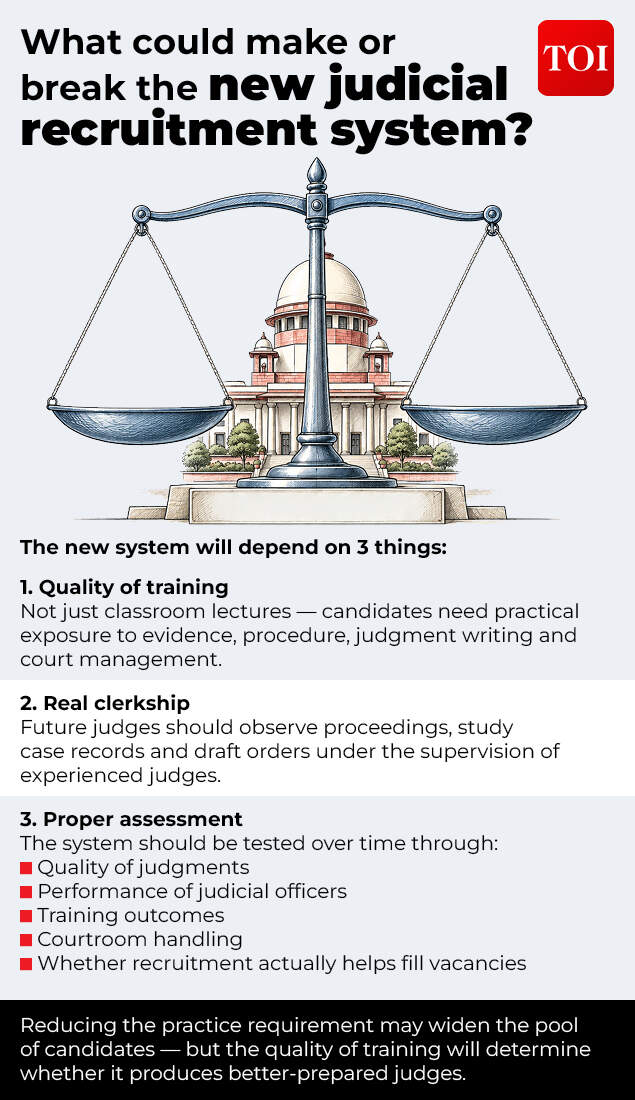
Will the new system help address judicial vacancies?The lawyers said the reform could help widen recruitment but should not be treated as an automatic solution to vacancies.Sharma pointed out that selected candidates would still spend two years in academy training and clerkship before regular posting. He said the impact of the new system should therefore be assessed on actual outcomes.He suggested reviewing the framework after five years using evidence on the quality of judgments, performance of judicial officers, training outcomes and whether the new recruitment pipeline actually helps address vacancies.Sijoria similarly said the reform should be viewed as a change in how courtroom readiness is acquired rather than simply as a dilution of the experience requirement.The debate, therefore, is not simply about whether a candidate has spent one year or three years at the Bar. It is about whether practical experience, judicial training and supervised clerkship together can produce a judicial officer with the maturity, courtroom understanding and discipline required to decide cases.While Sharma and Sijoria believe the new framework can work if properly implemented, Justice Sanghi remains of the view that three years of professional experience should remain a prerequisite for entering judicial service.