









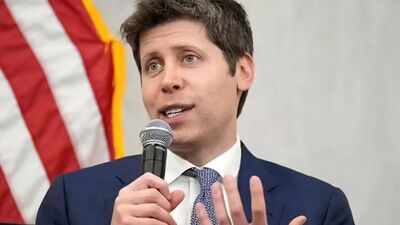
The latest generation of artificial intelligence has prompted plenty of discussion about what machines can now achieve, but one recent comment from OpenAI chief executive Sam Altman drew attention for a much more personal reason. Rather than focusing on benchmark scores or technical improvements, Altman shared a moment from life at home after watching his older child combine two words for the first time. He compared that milestone with something he had recently seen from GPT-5.6, OpenAI’s newest family of language models, according to his recent X(Formerly Twitter) post. The comparison quickly spread online because it linked two very different forms of learning: the early stages of human language development and the growing abilities of advanced AI systems. It also arrived at a time when OpenAI was introducing its latest models under tighter release conditions than many people expected, with wider public access still on hold while discussions with the US government continue.
How Sam Altman’s child’s first words reminded him of GPT-5.6
‘Our older kid put two words together for the first time, and I am approximately as amazed by this cognitive feat as I am by GPT-5.6 discovering new math’, says Sam Altman.The remark was brief but reflected two separate milestones that happened to coincide. One was a familiar stage in early childhood, when a child begins joining words into simple phrases rather than speaking isolated words. The other referred to improvements demonstrated by OpenAI’s latest AI model, which the company says is capable of tackling more demanding reasoning tasks than previous systems.Instead of presenting the comparison as a scientific claim, Altman framed it as a personal reaction. His post highlighted how moments of learning, whether in a child or an AI model, can inspire a similar sense of curiosity despite being fundamentally different processes.
What OpenAI has announced with GPT-5.6
OpenAI recently introduced the GPT-5.6 family, consisting of three separate models designed for different kinds of users and workloads.The flagship model, GPT-5.6 Sol, has been presented as the company’s most advanced system to date. Alongside it sits GPT-5.6 Terra, intended for broader day-to-day use, while GPT-5.6 Luna is designed to deliver faster responses with lower operating costs. OpenAI has also said the new generation includes its strongest safety protections so far, reflecting the company’s growing focus on reducing harmful outputs while expanding capability.Although the models represent the next step in OpenAI’s development, they have not yet reached the wider public.
Why the wider launch has been delayed
Many users expected GPT-5.6 to become widely available shortly after its announcement. Instead, OpenAI has chosen a limited preview involving a relatively small group of trusted partners.As reported by Fortune, Altman later explained that the change in rollout plans came after a request from the US government. According to him, the company had originally intended to release the models through open access but instead began with a restricted preview while discussions continue with government officials.He also indicated that OpenAI hopes to move towards general availability as quickly as possible. At the same time, he acknowledged that staged releases make sense for increasingly capable AI systems, even if the current process is not the company’s preferred long-term approach.
OpenAI says transparency and safety will shape future AI launches
According to the May 2026 official release, OpenAI has said it is collaborating with the US government on a framework intended to make future launches more transparent while addressing safety and security concerns surrounding increasingly powerful AI systems.The company has stressed that government previews are not intended to become the standard way new models are introduced. Its stated goal remains broader access for developers, businesses and everyday users once the current review process has been completed.That reflects the wider debate taking place across the AI industry, where developers are balancing rapid technological progress with growing calls for oversight and responsible deployment.
Why Altman’s comparison attracted attention
The online response to Altman’s post stemmed largely from its unusual mix of personal life and technological progress. Public discussions about AI often centre on technical specifications, commercial competition or regulation. His comment instead connected a family experience with advances in machine intelligence.The comparison did not suggest that human learning and artificial intelligence develop in the same way. Rather, it expressed the excitement of witnessing two different kinds of progress: one through the natural development of a young child, and the other through years of engineering and research.As GPT-5.6 continues its limited rollout, the post has become one of the more widely discussed moments surrounding the launch, offering a glimpse of how the OpenAI chief viewed both a personal milestone at home and a significant step forward for the company’s newest AI models.