








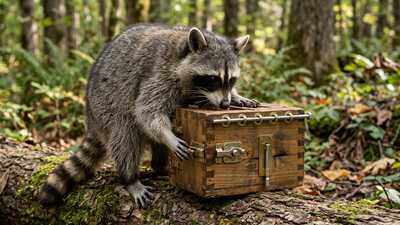
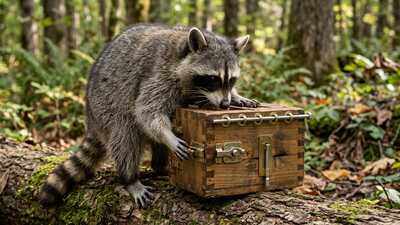
Imagine leaving a locked food box in your backyard and returning the next morning to find it open. Now imagine that every raccoon opened it differently. That is exactly what happened during an experiment in Laramie, Wyoming, where researchers installed specially designed puzzle boxes to test the problem-solving abilities of wild raccoons. Equipped with four different locking mechanisms, the boxes were intended to challenge the animals. Instead, many raccoons solved them using their own unique techniques, revealing remarkable flexibility, learning and innovation. The findings suggest that these familiar urban mammals are far more adaptable than previously thought, helping explain why they thrive in cities and suburbs across North America.
A puzzle box designed to outsmart raccoons
The study was carried out by researchers from the University of Wyoming and the University of British Columbia, who wanted to understand how wild raccoons solve unfamiliar problems in real-world environments rather than laboratory settings.Instead of testing captive animals, the team installed specially built puzzle boxes in suburban backyards, a commercial feed store and an abandoned barn around Laramie. Before the experiments began, raccoons were humanely captured, examined, fitted with passive identification tags and released back into their home ranges so researchers could identify individual animals during the trials.The multi-access puzzle box contained food rewards hidden behind four different locking systems:
- A side-pull bolt latch
- A pull-down bolt
- A swivel latch
- A metal rod threaded through an eye hole
Each mechanism required a different action, allowing scientists to observe whether raccoons relied on a single successful strategy or developed multiple ways to access the food.
Every successful raccoon found its own solution
The results surprised even the researchers. Around one in four wild raccoons successfully opened the multi-lock puzzle box. More importantly, the animals rarely relied on a single technique. Individual raccoons often discovered several different ways to unlock the box, sometimes approaching the very same mechanism from different angles or using completely different movements.The study ‘Wild raccoons demonstrate flexibility and individuality in innovative problem-solving’, published in the journal Proceedings of the Royal Society, found considerable variation between individuals. Some raccoons were persistent and exploratory, repeatedly testing new approaches until one worked. Others were more cautious but still developed effective solutions after gaining experience.According to the researchers, this behavioural flexibility is a hallmark of innovation. Rather than simply repeating behaviours through trial and error, the animals adjusted their actions when faced with new challenges, demonstrating an ability to modify learned behaviours depending on the situation.
Younger raccoons proved to be the boldest learners
Age appeared to play an important role in the experiment.Researchers found that juvenile raccoons were generally more willing to investigate unfamiliar objects and attempt new solutions than older adults. Younger animals often accepted greater risks in exchange for the possibility of obtaining food, whereas older raccoons tended to behave more cautiously.The team also discovered that raccoons that initially failed simpler puzzle boxes could later succeed after mastering easier tasks. This suggests that learning one solution increased their confidence and ability to solve increasingly difficult problems.Lead researcher Lauren Stanton explained that the findings demonstrate how “learning begets learning” basic experiences can provide the motivation and knowledge needed to tackle more complex challenges.
Why raccoons thrive in cities
Raccoons have become one of North America’s most successful urban mammals. Their ability to exploit rubbish bins, bird feeders and other human food sources has long suggested high intelligence, but scientists had surprisingly little evidence showing how wild raccoons solve novel problems.This study indicates that their success is not simply the result of persistence. Instead, different individuals display different personalities, levels of curiosity and problem-solving styles. Such behavioural diversity may help reduce competition because animals exploit food resources in different ways.Researchers believe these cognitive abilities help raccoons adapt rapidly to changing urban environments where food sources, obstacles and human behaviour constantly evolve.
A smarter backyard visitor than many realise
The experiment highlights how adaptable wildlife can be when living alongside humans. Rather than relying solely on instinct, raccoons demonstrated learning, innovation and behavioural flexibility, traits more commonly associated with highly intelligent animals.The researchers say understanding how raccoons solve problems could also improve wildlife management strategies, including the design of devices used for conservation, disease monitoring and oral rabies vaccination programmes. At the same time, the findings offer a fresh perspective on one of North America’s most misunderstood mammals.The next time a raccoon manages to open a supposedly secure rubbish bin, it may not simply be acting on instinct. It could be solving the problem in a way no other raccoon has thought of before.