









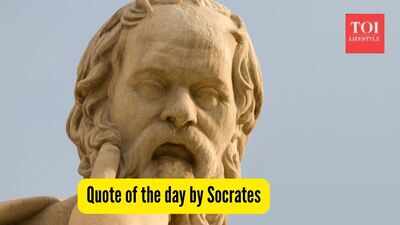
More than 2,400 years after his death, Socrates continues to shape the way people think about knowledge, ethics, leadership and even everyday conversations. Like so many of the famous philosophers, he never wrote a book. But his ideas so changed western philosophy that he is regarded as one of the greatest minds in human history.His legacy continued through the writings of his students, especially Plato. Plato’s dialogues exposed generations of readers to Socrates’ odd method of questioning everything from justice and courage to friendship and happiness. Socrates was born in Athens, Greece around 470 B.C.E. at a time when the city was emerging as one of the great centers of political, cultural and intellectual life in the world. His father Sophroniscus is said to have been a stonemason or sculptor, and his mother Phaenarete a midwife. His unconventional style often made people question their long-held beliefs.The Socratic Method: Questioning rather than answeringPerhaps Socrates’ greatest contribution was not a set of answers, but a way of thinking. He asked questions, didn’t lecture. As the discussion went on, people often found that their definitions were inconsistent or incomplete. This approach, now called the Socratic Method, is still used in law schools, medical education, business schools and classrooms around the world. Students are encouraged to analyse, question and reason things out for themselves rather than learning by rote. Socrates held that true wisdom begins in knowing that you don’t know much.This is beautifully expressed in his famous statement recorded by Plato: “I know that I know nothing.” It is often oversimplified but the concept is a manifestation of intellectual humility – the realisation that we start to learn when we acknowledge our own shortcomings.Socrates thought that people do wrong things because they are wrong about what is truly good. He thought that if people really knew what was right, they would of course do right. Character is more important than possessions. He said that many accepted beliefs persist solely because people never bother to examine them. Socrates was tried for his life because he was accused of corrupting the minds of the youth of Athens and of refusing to honour the gods of the city.He humiliated the powerful Athenians by constantly questioning and challenging accepted beliefs.In 399 BC he was tried on two main charges-corrupting the young men of Athens, not believing in the gods of the city.Many historians think that the trial was heavily influenced by the political strife that followed Athens’ loss in the Peloponnesian War. Plato recorded the defence speech Socrates gave at his trial in Apology. He would not desert his philosophical mission, nor flatter the jury into mercy. The court found him guilty and sentenced him to death.Socrates was offered an opportunity by friends to escape from prison. He wouldn’t. Socrates thought that citizens should obey the laws of their society, even if the laws were unfair to them. To run away, he argued, would be to betray the very principles of justice to which he had devoted his life. His sentence was passed. He drank a cup of poison hemlock with an unruffled air.His death made him one of the greatest symbols of intellectual integrity in history.His impact on the worldSocrates himself wrote nothing, but his influence was carried forward by his students. Plato established the Academy, which was one of the first great institutions of higher learning in history. Plato’s own student Aristotle would shape philosophy, science, politics and ethics for centuries to come. Socrates, Plato and Aristotle together laid the foundations of much of the Western philosophy. Quote of the DayOne of the famous quotes attributed to Socrates is, “Strong minds discuss ideas, average minds discuss events, weak minds discuss people”The quote is frequently shared online and often appears in books, speeches and social media posts, but scholars have found no evidence that it appears in Plato’s dialogues, Xenophon’s writings or other ancient sources linked to Socrates. Many researchers are of the opinion that the quote is a much later creation that was attributed to his name because it resembles his style of thinking. But strangely enough, the message fits with Socratic philosophy. According to the lines, people who are intellectually curious like to explore ideas. They don’t just focus on what’s happening today, but ask questions like-what can make society more equal, what makes a good leader? What makes people happy? Idea-based discussions inspire creativity, innovation and deeper understanding. Average minds discuss events. It isn’t wrong to discuss current events.People naturally talk about elections, sports matches, scientific discoveries, business news, or family celebrations. But if conversations never move from “what happened” to “why it happened” or “what it means,” deeper learning opportunities can be missed. The weak mind speaks of people. This portion of the quotation has often been interpreted as a warning against gossip. If conversations are mainly about judging, criticising or speculating about other people’s lives there is little space for personal growth. Socrates always told us to look at ourselves and our own actions and to not worry about the faults of other people.That’s not to say it’s always wrong to talk about people. Studying the lives of inspiring leaders, scientists or artists can teach us valuable lessons. The quote rails against chats fuelled by idle gossip, personal attacks or unneeded criticism. How the message is still relevant today. In a world saturated with notifications, celebrity gossip and social media debates, the quote resonates because it encourages people to raise the bar of their conversations. Socrates spent his life posing thoughtful questions that challenged assumptions and invited reflection. Whether or not he actually said these famous words, the sentiment expresses a philosophy that he truly lived by: wisdom is increased when we pay less attention to judging others and more to seeking truth, understanding and better ideas.More than two millennia after his death, Socrates reminds us that intelligence is not about how many answers we have, but how many questions we ask and how much we are willing to learn throughout our lives.