








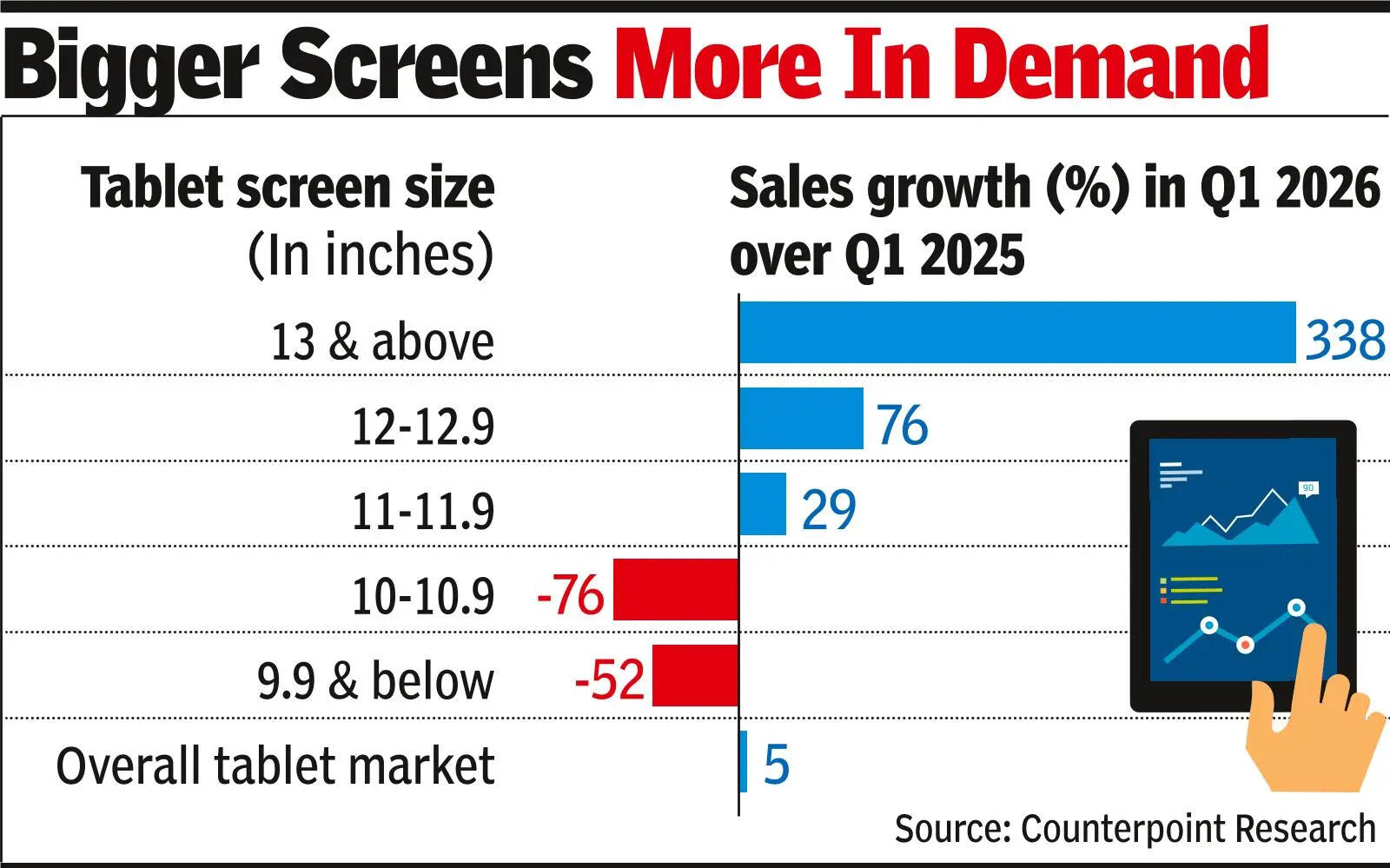
NEW DELHI: As laptop prices rise, tablet makers are making a stronger play for everyday computing, armed with bigger screens, more memory, keyboards and increasingly PC-like multitasking capabilities.The shift is showing up in what Indians are buying. Research agency CMR said India’s tablet market grew 37% year-on-year during Jan-March 2026, with devices priced above Rs 20,000 accounting for 86% of shipments and growing 92%. Tablets with screens larger than 10 inches made up nearly 90% of market. Demand is also moving towards higher specifications. Tablets with 6GB RAM grew 284% y-o-y during the quarter, while 12GB variants surged 835%.Counterpoint data pointed to the same direction. Shipments of tablets with screens of 13 inches and above jumped 338% in Q1, while 12-inch devices grew 76% and 11-inch tablets 29%. Tablets below 10 inches fell 52%.“The distinction between a tablet and a laptop will continue to narrow significantly over next two-to-three years,” a Xiaomi spokesperson told TOI, adding that tablets could take over an increasing share of everyday computing even if specialised workloads continue to favour PCs.
India’s tablet market surges as rising laptop prices push consumers towards larger, more powerful tablets
HP sees the shift less as a replacement cycle and more as an expansion of computing into different form factors. “PC penetration remains at around 17% and we know that as households continue to prioritise education and invest more in technology for learning, work and productivity, the opportunity lies in expanding access to computing through a broader range of form factors,” said Vineet Gehani, senior director, personal systems, HP India.He said products such as OmniPad were aimed at students, educators, young professionals and small businesses seeking mobility and a touch-first experience, but with productivity features such as detachable keyboards.Xiaomi said 81% of tablets shipped in India during Oct-Dec 2025 were productivity-focused, while devices with screens of 11 inches and above accounted for 85% of shipments.The timing matters. Both laptop and tablet average selling prices rose in double digits in first half of 2026, according to Counterpoint’s Anshika Jain, with notebook prices increasing more sharply during the memory-price cycle.Jain cautioned against calling it a wholesale laptop replacement. The shift is strongest in online education, content consumption and light productivity, particularly where buyers might otherwise have chosen an entry-level notebook. HP takes a similar view. Gehani said laptops would remain preferred option for demanding productivity, content creation and computing workloads, while tablets and PCs were likely to co-exist as consumers chose devices based on specific use cases.The tablet market itself is not uniformly buoyant. Counterpoint estimated overall Q1 growth at 5%, while CMR expects the market to decline 10-12% for full year.