









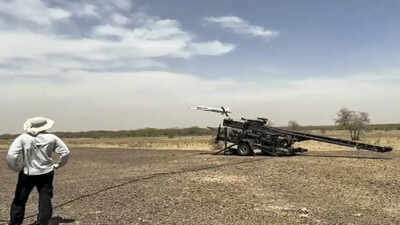
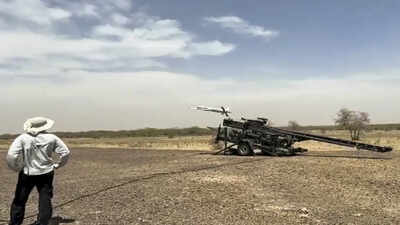
As drone warfare takes centre stage, an Indian private company, Nibe Limited, has completed the No Cost No Commitment (NCNC) demonstration of the Vayu Astra Loitering Munition (LM). The Vayu Astra has now cleared the demonstration in both mountainous terrain in Malari in Joshimath and desert terrain in the Pokhran area. The LM is capable of carrying a 10 kg warhead, this is a larger warhead than both the Nag anti-tank missile and a 155mm artillery shell, thus giving the operator and field commanders greater options while engaging targets. This is a very early phase of trials for the system. The LM has demonstrated the ability to carry both anti-tank and anti-personnel warheads, up to a range of 100 km.Unlike the drones made famous in the conflict in West Asia and in Ukraine, which fly on a fixed path to a target a loitering munition is connected to an operator via a two-way link. This allows the operator to observe the area over which the Loitering Munition is flying. This gives commanders the option to patrol or loiter over an area till a suitable target is found. Once a suitable target is found the drone operator flies into the target and blowing it up. The LM can also be used as a reconnaissance asset, which can be safely recovered via an inbuilt parachute. These systems were used by the air force and the army during Operation Sindoor.
The firm, carried out the firing of the EXTRA and Predator Hawk systems at the Integrated Test Range located at Chandipur in Odisha. These rockets are part of the Suryastra Multi-Barrel Rocket Launcher (MBRL) platform that the army demonstrated during the Republic Day parade this year. The Suryastra, is derived from the Precise & Universal Launching System (PULS) system developed by Israel based Elbit systems. This MBRL system can be used to hit targets as far as 300 km away and will complement the indigenous Pinaka MBRL system.