








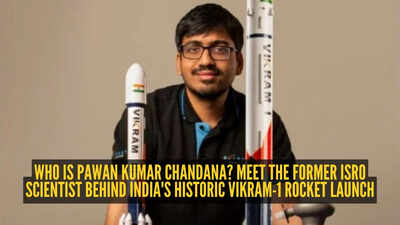
Until a few years ago, Pawan Kumar Chandana was one of many engineers working quietly at ISRO. Outside the space community, hardly anyone knew his name.Today, that’s changed.On Saturday, as Skyroot Aerospace’s Vikram-1 successfully reached orbit from Sriharikota, Chandana found himself at the heart of one of the biggest moments in India’s private space journey. The mission wasn’t just another rocket launch. It was the first time a privately built Indian rocket successfully entered orbit, a milestone many believed was still years away.For Chandana, it was the result of a decision that once seemed almost impossible to justify—walking away from a secure job at ISRO to build a rocket company from scratch.
Growing up in Hyderabad
Chandana was born and raised in Hyderabad in a middle-class family, where education was always taken seriously.By all accounts, he wasn’t one of those children who topped every exam without trying. In interviews and reports about his journey, there’s a recurring theme: mathematics and science didn’t always come naturally to him.Like many students, he had subjects he struggled with.But instead of giving up, he kept working at them. His father encouraged him to stay focused, and over time those very subjects became the foundation of the career he would eventually build.It’s a reminder that even people who go on to design rockets don’t necessarily have a perfect report card growing up.
The IIT dream
Engineering was always the goal.After school, Chandana prepared for the IIT entrance exam and cleared it on his very first attempt—a moment that changed the direction of his life.He joined IIT Kharagpur in 2007 and completed a dual degree in Mechanical Engineering.Those five years gave him far more than classroom knowledge. They introduced him to the kind of engineering challenges that would later define his career.When campus placements came around in 2012, he landed a job that many engineering graduates only dream about – ISRO.
Six years at India’s space agency
Working at ISRO meant Chandana was involved in the country’s space programme at a time when India was steadily making its mark globally.For most people, that would have been the finish line.For him, it slowly became the starting point of another idea.
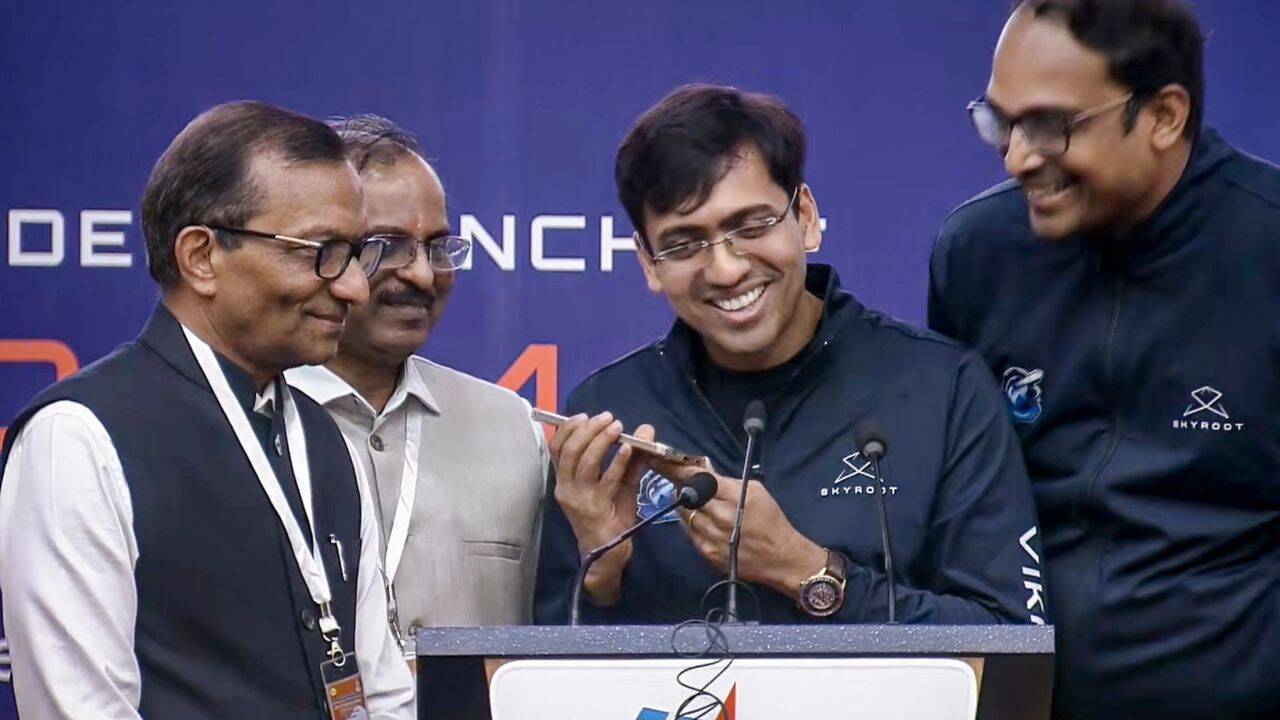
Skyroot Aerospace CEO and founder Pawan Kumar Chandana and co-founder Naga Bharath Daka speak with Prime Minister Narendra Modi over the phone from Sriharikota after the successful maiden launch
He had been watching how private companies abroad were beginning to change the space industry. Rockets were no longer being built only by government agencies. Start-ups were entering the race too.He couldn’t shake off one question: Why couldn’t India do the same?
Leaving the comfort of ISRO wasn’t easy
A government job at ISRO brings stability, respect and security.Walking away from it to start a company that wanted to build rockets sounded risky by any standard.But in 2018, Chandana and fellow ISRO engineer Naga Bharath Daka decided to take that chance.The two founded Skyroot Aerospace in Hyderabad with a belief that private companies could play a much bigger role in India’s future space missions.Back then, there wasn’t really a blueprint to follow.They had to build one themselves.
One rocket at a time
The company’s first breakthrough came in 2022 with Vikram-S, a suborbital rocket that proved the team could build and launch a rocket successfully.That mission didn’t make as many headlines as Vikram-1 has today, but inside India’s growing space-tech ecosystem, it was a huge moment.It gave Skyroot confidence – and it showed investors that the company was serious.Over the next few years, the team kept building, testing and improving.Saturday’s Vikram-1 launch was the result of all those years of work finally coming together.
Skyroot today
What started as a small startup has grown remarkably quickly.Skyroot now employs over a thousand people and has attracted significant investment, including a funding round earlier this year that pushed the company into the unicorn club.Its Hyderabad facility has also expanded, with the capacity to manufacture orbital rockets at a much faster pace than before.For a company that began with a handful of engineers chasing an ambitious idea, that’s no small achievement.
More than just one successful launch
The Vikram-1 mission is significant not only because the rocket reached orbit.It signals something much bigger.For decades, India’s space story was almost entirely written by ISRO. Now, private companies are beginning to write their own chapters too.That’s good news not just for entrepreneurs, but for India’s ambitions to become a major player in the global commercial space industry.
Who is Pawan Kumar Chandana?
He’s an engineer who chose uncertainty over comfort.A former ISRO scientist who believed private companies could build world-class rockets in India.And after Vikram-1’s successful mission, he’s also the man many people will remember as the CEO who helped prove that India’s private space sector is ready to aim much higher.